Introduction
Showing up to a trade show or brand activation with the wrong display doesn't just hurt aesthetics — it actively works against you. In a packed expo hall, prospects form impressions in seconds, and a flimsy display tells prospects your brand cuts corners.
The U.S. B2B trade show market reached $15.8 billion in 2024 and is forecast to grow to $17.62 billion by 2026. With that level of investment across the industry, the brands that show up with sharp, well-fabricated displays have a clear competitive edge.
This guide covers five proven portable display types: retractable banner stands, pop-up displays, tension fabric/SEG systems, backlit LED displays, and step-and-repeat backdrops. For each, you'll find what it does well, where it falls short, and which event environments it fits best.
Key Takeaways
- Retractable banner stands are the fastest, most affordable entry point for portable event presence
- Pop-up and tension fabric displays create the high-impact backdrops needed to stop foot traffic
- Backlit LED displays outperform standard displays in visually complex, competitive environments
- Step-and-repeat backdrops generate branded photo content that extends event reach organically
- Graphic quality determines whether your display looks polished and on-brand — hardware alone won't carry it
Overview of Portable Displays in the Marketing Events Industry
Portable marketing displays are branded, freestanding or modular structures designed for quick deployment at trade shows, conferences, brand activations, pop-up stores, and experiential events — without requiring permanent installation or professional labor.
EXHIBITOR Magazine's 2025 Economic Outlook found that more than 25% of exhibitors expected their event marketing budgets to increase in 2025, with another 43% holding steady. Brands are attending more events and demanding more from their display systems.
Dozens of display formats exist — and choosing the wrong one wastes budget and misses audience impact. The breakdown below covers the five most effective portable display types, what each does well, and where each falls short.
Best Portable Displays for Marketing Events
Displays below were evaluated on five criteria: portability, setup speed, graphic impact, reusability, and versatility across event types.
Retractable Banner Stands
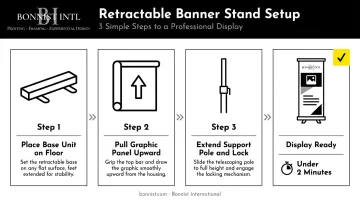
Retractable (roll-up) banner stands are the most widely used portable display in event marketing. A single graphic panel rolls into a base unit and retracts for transport — the entire thing fits in a slim carrying case.
What makes them practical: near-instant setup (under 2 minutes), wide availability of custom print sizes, and a low unit cost. For brands new to events, or brands adding a side display to an existing booth, they're the logical starting point.
| Attribute | Details |
|---|---|
| Best For | Solo exhibitors, side displays, retail pop-ups, conferences |
| Typical Size Range | 24" x 60" to 33" x 80" graphic area |
| Key Advantage | Fastest setup and most portable; fits in a carry bag |
Pop-Up Displays (Collapsible Frame with Graphic Panels)
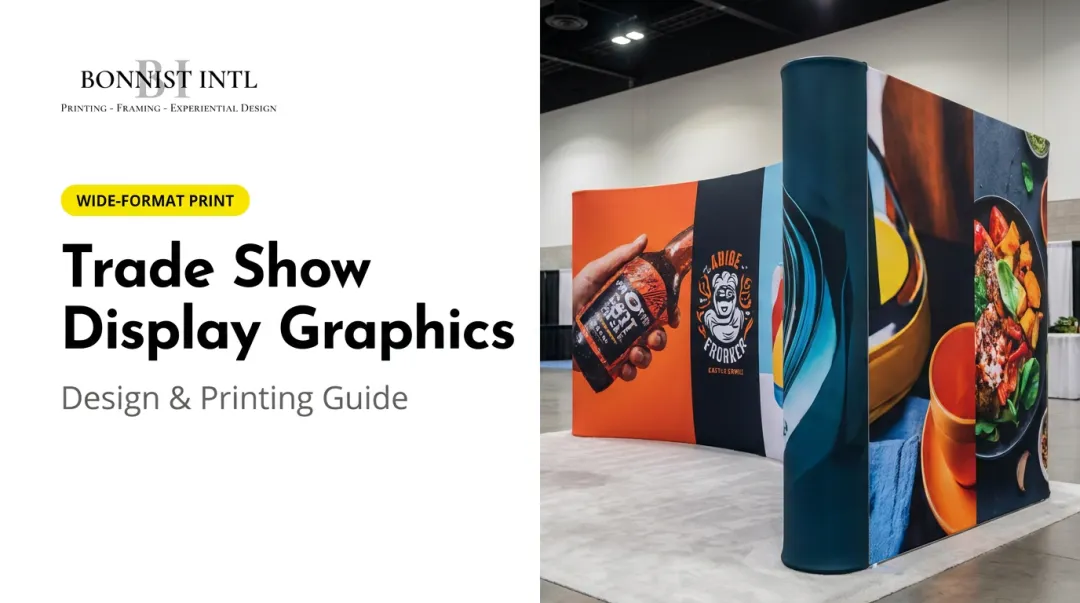
Pop-up displays use a collapsible accordion-style aluminum frame that expands to support fabric or graphic panels, creating a seamless curved or straight backdrop. They're a standard fixture in 10x10 and 10x20 trade show booths.
The appeal is the visual payoff relative to setup effort. A full 8- to 10-foot backdrop goes up without tools, and dye-sublimated fabric panels deliver vibrant, edge-to-edge color that photographs well. The finished booth reads as a complete branded space — no tools, no construction.
| Attribute | Details |
|---|---|
| Best For | Trade show booths, brand activations, career fairs, product launches |
| Typical Size Range | 8' to 20' wide, configurable curved or straight |
| Key Advantage | High visual impact, fast assembly without tools, reusable frame with swappable graphics |
Tension Fabric Displays (SEG / Silicone Edge Graphics)
Tension fabric displays stretch a dye-sublimated fabric graphic over a lightweight aluminum extrusion frame, with the fabric edge tucked into a silicone channel (SEG) for a taut, seamless finish. It's a step forward from standard pop-up technology, and the difference shows in the finished look.
The frameless finish removes visible borders and hardware from the display face, giving the graphic a clean, print-quality appearance that reads as intentional and premium. Graphics are machine washable and can be swapped between campaigns without replacing the frame, making SEG systems cost-effective for brands attending multiple events annually.
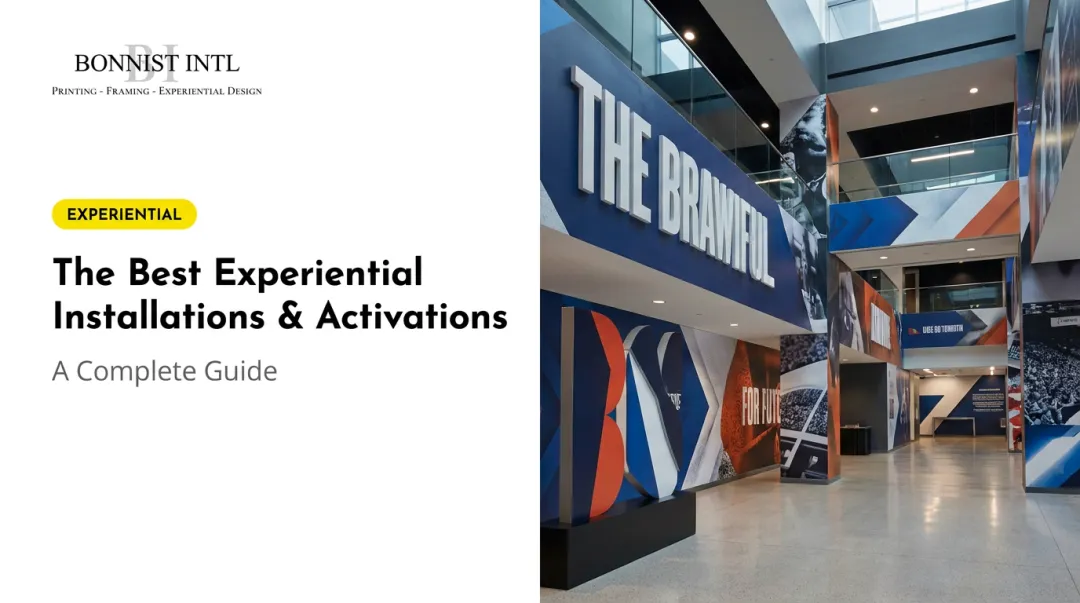
Bonnist International produces backlit SEG displays as a core service, with documented projects spanning national sports leadership summits and corporate conferences. Their SEG displays are built for repeated event use — the frame carries over across campaigns while graphics are updated per event.
| Attribute | Details |
|---|---|
| Best For | Corporate events, hospitality activations, upscale brand experiences, modular booth systems |
| Typical Size Range | Customizable from tabletop (2' x 4') to wall-scale (20'+) configurations |
| Key Advantage | Premium, print-quality finish; reusable frame; lightweight and tool-free assembly |
Backlit LED Light Box Displays
Backlit displays mount an illuminated LED panel behind a translucent fabric or acrylic graphic, producing a glowing display that commands attention in competitive expo environments. LED technology runs cool and efficiently — according to Displays2go, LED bulbs in light box systems are rated for over 100,000 hours, lasting up to 5x longer than fluorescent alternatives.
The practical advantage is visibility. In a dimly lit convention hall or a visually dense expo floor, an illuminated display simply outperforms a non-illuminated one. The perceived quality boost justifies the higher cost for brands where premium positioning matters — luxury products, high-ticket services, or competitive categories where first impressions drive booth traffic.
Bonnist's backlit SEG systems have been deployed at professional sports leadership summits, where the illuminated format drove photo activity at the display and reinforced the event's brand presence throughout the venue.
| Attribute | Details |
|---|---|
| Best For | High-competition trade shows, product launches, luxury or premium brand events |
| Typical Size Range | 2' x 2' lightbox panels to modular walls up to 10'+ wide |
| Key Advantage | Maximum visual impact and brand prestige; works in dimly lit event environments |
Step-and-Repeat Backdrops
Step-and-repeat backdrops feature a tiled, repeating logo or brand pattern on a flat fabric or vinyl panel mounted on a telescoping frame. Originally a red-carpet staple, they're now standard at corporate galas, award ceremonies, product launches, and any event with media, influencers, or social sharing.
The mechanism is straightforward: every photo taken in front of the backdrop becomes branded content. Guests share event photos, the brand's logo appears in each image, and event reach extends well beyond the attendees who were physically present. As Forbes noted in 2024, events generate content that can be repurposed across social platforms, blogs, and newsletters — and step-and-repeat backdrops are built specifically to fuel that pipeline.
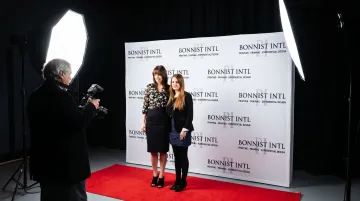
Bonnist produces step-and-repeat banners for press events, red carpet occasions, and corporate gatherings, with an NBA/AWS co-branded backdrop as a documented example of the format in action.
| Attribute | Details |
|---|---|
| Best For | Award ceremonies, corporate galas, sponsorship events, product launches, influencer activations |
| Typical Size Range | Standard 8' x 8' up to larger configurations for high-traffic photo areas |
| Key Advantage | Organic branded content generation; high reuse value; easy to swap graphics per event |
How to Choose the Right Portable Display for Your Marketing Event
Start with the Event Environment
The physical setting is your first filter. An indoor trade show booth, an outdoor festival footprint, a hotel ballroom activation, and a retail pop-up each have different demands:
- Indoor trade shows — lighting conditions vary; backlit displays gain the most advantage
- Outdoor activations — wind resistance, weighted bases, and weather-rated materials are non-negotiable
- Hotel ballroom or conference settings — tension fabric SEG systems fit the premium environment
- Retail pop-ups — retractable banners and modular fabric displays balance portability with visual presence
Match Display Size to Audience Flow
A solo retractable banner works in low-traffic environments where you're adding supplementary brand presence. When the goal is to create a destination — a booth that stops foot traffic and draws people in — you need a full pop-up or tension fabric backdrop to create the visual weight that commands attention from across an aisle.
Factor In Reusability
Brands attending three or more events per year should prioritize frames that support graphic replacement. Consider this: a tension fabric SEG frame used across six events with two graphic swaps costs far less per event than buying a new display each cycle. Bonnist's SEG systems are specifically designed as reusable assets, with graphic swaps anticipated from the outset.
Budget for Graphics Quality, Not Just Hardware
The display frame is only half the investment. Print resolution, color accuracy, material finish, and dye-sublimation quality determine whether the display looks professional or cheap — and this is where brands most commonly underinvest. Reusability savings only hold up if the graphics are worth reusing.
Working with a fabrication partner like Bonnist International — 33 years in custom visual display production for corporate, sports, hospitality, and e-commerce brands — ensures graphic quality is matched to the hardware from the start.
Consider Portability Logistics
A few practical factors worth checking before you commit:
- Can one person set it up without tools?
- How many carrying cases fit in a rental car or shipped freight?
- Does the display have a hard deadline where setup time matters?
These factors determine whether a display is actually usable under real event conditions, or becomes a logistical problem once you're on-site.
How We Evaluated These Displays
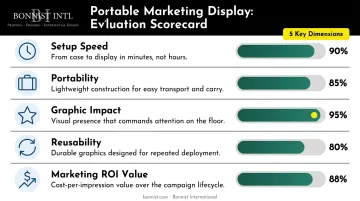
Displays in this guide were assessed on five dimensions:
- Setup speed — time from case to display-ready
- Portability — pack-down weight and case dimensions
- Graphic impact — visual quality and brand representation potential
- Reusability — frame durability and graphic swap compatibility
- Value for marketing ROI — total cost of ownership across multiple events
The most common mistake brands make is prioritizing low upfront cost over long-term value. A $200 banner stand that looks cheap, can't be updated, or falls apart after three events costs more in the end than a $1,500 tension fabric system that runs for five years.
Your display is part of your brand presentation. Attendees form impressions of your company the moment they see your booth — a flimsy or faded display signals the same about your product.
Conclusion
Choosing the right portable display is a brand decision as much as a logistics one. The format you select determines whether a prospect stops at your booth or keeps walking — and in a crowded event environment, that first visual impression is what drives foot traffic.
Before investing in a display system, map your full event calendar. Consider how many events you attend annually, what messaging updates you'll need to make, and whether one versatile display covers your needs or whether a layered combination — a step-and-repeat for photo moments, tension fabric for the main booth, and banner stands for side presence — makes more sense.
For brands that want displays custom-designed and fabricated to their exact standards, Bonnist International has spent over 33 years building custom visual display solutions for corporate, sports, hospitality, and e-commerce clients. Contact their team to discuss your next event.
Frequently Asked Questions
What types of portable displays work best for outdoor marketing events?
For outdoor use, prioritize displays with wind-resistant frames, weighted or stake-anchored bases, and weather-resistant print materials. Outdoor-rated retractable banner stands with water-fillable bases, tension fabric displays on weighted stands, and feather or teardrop flags are the most reliable options.
How much do portable marketing displays for events typically cost?
Costs vary by type: retractable banner stands run $100–$265, printed fabric pop-ups range from $800 to $3,700, and backlit LED booth systems typically cost $2,500 to $4,900. Always budget for the frame, printed graphic, carrying case, and any lighting together.
How long does it take to set up a portable display at an event?
Retractable banner stands take under 2 minutes. Pop-up displays typically take 10–20 minutes. Tension fabric SEG systems run 20–45 minutes depending on size and whether the frame uses tool-free connections. Factor setup time into your event logistics — especially if you're working with a small team.
Can portable marketing displays be reused for multiple events?
Quality display frames are built for repeated use across many events. Systems with swappable graphics — SEG tension fabric displays and pop-ups with replaceable panels — allow brands to refresh messaging or seasonal campaigns without replacing the full display, which significantly reduces per-event cost over time.
What is the difference between a pop-up display and a tension fabric display?
Pop-up displays use a collapsible accordion frame with attached graphic panels that expand quickly for fast setup. Tension fabric displays use an aluminum extrusion frame with a silicone-edge fabric graphic that tucks into a channel groove, creating a tighter, frameless finish with cleaner graphic presentation.
How do I make my event display stand out in a crowded trade show environment?
Three approaches make the biggest difference: upgrading to a backlit LED display for visibility in busy, mixed-lighting environments; investing in high-resolution dye-sublimated graphics with bold, on-brand color; and incorporating dimensional or modular elements that add depth beyond a flat graphic backdrop.