Introduction
A watercolor fades. A signed print darkens along its mat edge. A rare document becomes brittle. These aren't worst-case scenarios — they're what happens when works on paper are framed without proper archival standards.
Paper is uniquely reactive. It absorbs acid from surrounding materials, responds to humidity fluctuations, and accumulates light damage that no conservation treatment can reverse. According to the Canadian Conservation Institute, highly light-sensitive paper objects can show a "just noticeable fade" in as little as 0.8 to 7 days under average daylight — and that damage is cumulative and permanent.
This guide covers what anyone managing framed works on paper needs to know:
- Why archival framing matters — and what's at stake without it
- The three core components that define archival standards
- How to spot non-archival warning signs in existing collections
- Display and care practices that protect pieces long-term
Whether you're overseeing a corporate art collection, a hospitality installation, or sports memorabilia displays, the framing decisions you make today determine what those pieces look like in 20 years.
Key Takeaways
- Archival framing uses acid-free, chemically stable materials and fully reversible techniques to protect works on paper from environmental damage.
- The three pillars are proper hinging, acid-free matting, and UV-filtering glazing — failure in any one compromises the entire package.
- Non-archival framing causes permanent damage — mat burn, foxing, and fading — that conservation cannot fully reverse.
- Display conditions (light, humidity, wall placement) matter as much as the framing materials themselves.
- Visual inspections every one to two years catch deterioration before it becomes irreversible.
Why Archival Framing Matters for Works on Paper
Canvas paintings are relatively forgiving. Paper is not.
Paper absorbs acid from adjacent materials, expands and contracts with humidity, and reacts chemically to airborne pollutants like nitrogen dioxide and ozone. Left in contact with non-archival materials — cheap mat boards, cardboard backing, pressure-sensitive tapes — the degradation process begins immediately and accelerates over time.
The Real Cost of Non-Archival Materials
Acidic mat boards and backing boards release gases that migrate directly into paper fibers, causing yellowing, brittleness, and dark staining concentrated along mat edges — a condition known as mat burn. MoMA's Conservation team describes mat burn as a stain that permanently weakens paper fibers and is difficult to remove or lighten. Once it sets, it stays.
Light damage follows the same logic. The NEDCC confirms that faded objects do not return to their original appearance — even when moved to dark storage. UV radiation bleaches and yellows paper; visible light fades dyes and inks; infrared radiation generates heat that accelerates oxidation.
The Principle That Defines Archival Practice
Every material and technique used in archival framing must be reversible, meaning removable without leaving a trace on the artwork. This matters because conservation science advances. A future conservator or framer must be able to safely re-treat or reframe a piece without fighting adhesive residue, staining, or physical damage introduced by the original framer.
What's at Stake
Framed works in corporate offices, hotel installations, and sports venues carry real monetary and institutional value. Bonnist International has produced framed pieces for clients across some of the most demanding display environments in the country:
- Madison Square Garden
- The Brooklyn Nets
- MSocial Hotel NYC
In settings like these, framed art and memorabilia are permanent visual fixtures. Archival framing is the baseline requirement for maintaining their integrity over years of public display.
The Three Pillars of Archival Framing: Hinging, Matting, and Glazing
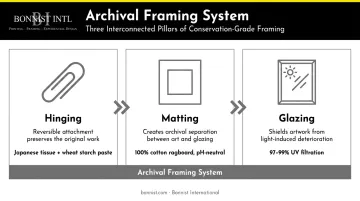
Archival framing is a system. Three interconnected components — hinging, matting, and glazing — must all perform correctly. Weakness in any one area undermines the protection provided by the others.
Hinging: Securing the Artwork Without Causing Damage
Hinging is how a work on paper is attached to its backing board. The governing requirement is reversibility: the hinge must come off cleanly, without tearing, staining, or chemically altering the paper.
The two main archival hinge types:
- T-hinge — extends slightly beyond the paper's edge and must be concealed by an overmat; the standard choice for matted presentations
- Folded hinge — placed entirely beneath the paper's edge; preferred when the full sheet is meant to be visible (a float presentation)
Both hinge types use Japanese tissue adhered with wheat starch paste or methyl cellulose. The Library of Congress specifies Japanese paper hinges with refined wheat starch paste as the preferred method when adhesive mounting is required at all — and notes that non-adhesive methods such as mounting corners are often preferable for delicate items.
What hinging is not:
- Full-surface dry mounting across the entire back of the paper — this is irreversible and not archival
- Pressure-sensitive or self-stick tape, even products marketed as "archival" — the Library of Congress explicitly warns these cause problems over time and are difficult to reverse without damaging the paper
- Standard linen tape, which can leave residue and restrict natural paper movement
Matting: Creating a Protective Environment Around the Artwork
The mat serves two functions: aesthetic presentation and physical separation of the artwork's surface from the glazing. That separation is critical. The mat serves two functions: aesthetic presentation and physical separation of the artwork's surface from the glazing. That separation is critical.
NEDCC notes that if moisture condenses inside the glazing and the artwork is in direct contact with it, the work can become physically adhered — a situation requiring professional conservation to resolve.
Archival mat board specifications:
- 100% cotton ragboard or chemically purified, lignin-free wood pulp
- pH neutral to slightly alkaline (the Library of Congress specifies pH 8.5 for archival applications)
- Minimum 4-ply thickness; 8-ply preferred for heavier or oversized works
- Calcium carbonate alkaline buffer — with one important exception: certain photographic media (albumen prints, cyanotypes, color photographs) are sensitive to alkalinity and require non-buffered board
The backing board directly behind the artwork carries the same requirements: acid-free and lignin-free. Acceptable options include acid-free corrugated board and corrugated polyethylene. NEDCC warns that poor-quality lignin-containing boards release acidic gases that stain, discolor, and embrittle paper over time.
Glazing: Shielding the Surface from Light and Contaminants
All works on paper require glazing — glass or acrylic — to protect the surface from dust, handling, and environmental pollutants. The critical specification is UV filtration.
UV glazing standards:
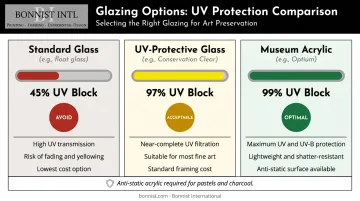
- Under PPFA framing guidelines, glazing labeled as UV-protective must block at least 97% of UV rays in the 300–380 nm range
- Conservation-grade products such as Tru Vue's Conservation Clear glass and Optium Museum Acrylic achieve 99% UV protection
- Standard clear glass blocks approximately 45% of UV radiation — far below archival thresholds
Special cases to know:
- Pastels and charcoal drawings require glazing with anti-static properties. Conventional acrylic carries a strong static charge that can physically lift friable media off the surface — a point NEDCC flags explicitly in its framing guidance
- UV-filtering acrylic (anti-static museum acrylic) solves both the weight and static concerns for large, light-sensitive works
- Light source matters beyond the frame: direct sunlight at 30,000 lux and halogen lighting are the most damaging sources for displayed works on paper; LED lighting is preferred because it emits neither UV nor infrared radiation
Choosing the Right Archival Materials: A Quick Reference
The table below summarizes what to use — and what to avoid — for each component of an archival framing package.
| Component | Archival Standard | Avoid |
|---|---|---|
| Hinges | Japanese tissue + wheat starch paste or methyl cellulose | Pressure-sensitive tape, linen tape, rubber cement |
| Mat board | 100% cotton ragboard or alpha-cellulose, 4–8 ply, pH-neutral/alkaline | Mat board with brown cardboard bevel (acidic) |
| Backing board | Acid-free corrugated board or corrugated polyethylene | Standard cardboard, newsprint, kraft paper |
| Glazing | UV-filtering glass or acrylic (≥97% UV block) | Regular glass, standard acrylic without UV filtration |
| Frame rabbet | Lined with aluminum or polyester barrier tape | Unlined wood rabbet in direct contact with mat |
| Dust cover | Acid-free paper or film, sealed with preservation-quality tape | Standard brown kraft paper |
A note on frames: Metal frames are inherently inert. Wood frames can be used, but the rabbet (the inner channel holding the framing package) must be lined with a barrier film such as aluminum or polyester tape to prevent wood acids from migrating into the mat package. The Library of Congress and NEDCC both specify this step.
Frame depth also matters: the frame must accommodate the full package — glazing, mat, artwork, and backing — without applying pressure to any layer.
Warning Signs That Your Framed Work on Paper May Not Be Archivally Framed
This checklist applies to anyone evaluating existing framed works, particularly pieces framed more than 15–20 years ago, when today's archival standards were not yet widely adopted. Six specific signs can tell you whether a frame is actively putting your artwork at risk.
- Brown or cardboard-colored mat bevel: A brown interior on the cut bevel confirms acidic mat board. Mat burn — darkening or yellowing along the window edge — may already be progressing.
- Yellowed or browned mat surface: Degraded mat board releases acid into any paper it contacts. Yellowing is a sign the process is active, not just cosmetic.
- Fading or brown discoloration across the artwork: Cumulative light damage is permanent — pigments cannot be restored once faded by UV or visible light exposure.
- Brown spots on the paper (foxing): Foxing results from mold growth or deterioration of metallic impurities in paper fibers. MoMA's conservation team notes that mold thrives on cellulosic materials when relative humidity exceeds 65%.
- No gap between the artwork and glazing: Direct contact between paper and glass traps humidity, causing surface irregularities and, in severe cases, physical adhesion. A mat or spacer should always separate the two.
- Irregular brown staining on the back of the paper: Typically caused by spray adhesives, rubber cement, or pressure-sensitive tape used during mounting — none of which are archival.
If any of these signs are present, the work should be evaluated by a professional framer before further deterioration occurs.
Best Practices for Displaying and Caring for Framed Works on Paper
Placement
- Hang on interior walls, not exterior walls — exterior walls experience greater temperature and moisture fluctuations
- Keep away from direct sunlight, halogen track lighting, working fireplaces, radiators, and HVAC intake or output vents
- Avoid areas with frequent foot traffic that generates vibration or creates localized humidity changes
Environmental Conditions
NEDCC's environmental guidelines for paper-based collections specify:
- Temperature: 70°F (21°C) or below
- Relative humidity: 30–50%
- Stability: Fluctuations matter more than absolute values — rapid swings cause paper to expand and contract, leading to warping, cracking, and hinge failure
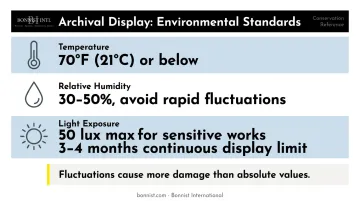
For light-sensitive items such as watercolors and photographs, NEDCC recommends display at 50 lux maximum and no more than 3–4 months of continuous exhibition. Permanent institutional displays should use UV-filtering glazing without exception.
Inspection Schedule
Schedule a visual inspection every one to two years for framed works in institutional or public display environments. Look for:
- Mat discoloration or bevel browning
- Foxing or new staining on the artwork
- Glazing damage, scratches, or condensation
- Frame joint separation or hardware loosening
- Any change in the artwork's surface appearance
Early detection keeps most damage reversible — by the time deterioration is visible, it's often already permanent.
Conclusion
Archival framing is the baseline standard for any work on paper that is meant to last — whether it's a watercolor in a hotel corridor, a signed print in a corporate lobby, or a player milestone display in an arena suite.
The materials and techniques that constitute archival framing add modest cost upfront. What they prevent is irreversible: mat burn, foxing, adhesion to glazing, and light fading that no conservation budget can undo after the fact.
That's why the framing partner you choose matters as much as the materials. Bonnist International has spent over 33 years producing professional framing solutions for high-traffic sports, hospitality, and corporate environments — from Madison Square Garden to MSocial Hotel NYC. For organizations that need framing built to hold up under real-world conditions while maintaining gallery-quality presentation, reach out to the Bonnist team at david@bonnist.com or call 845-641-4864 to discuss your project.
Frequently Asked Questions
What is archival framing?
Archival framing (also called conservation or preservation framing) uses chemically stable, acid-free materials and fully reversible techniques to protect works on paper from light, humidity, acid migration, and airborne pollutants. The defining requirement is that every material used can be removed without damaging the artwork.
What are the three types of framing?
Standard framing uses basic commercial materials with no preservation intent. Conservation or archival framing uses acid-free, reversible materials specifically to protect the artwork. Museum-grade framing applies the most rigorous standards — UV-opaque glazing, custom conservation mats, and institutional-level environmental controls.
What is an archival mounting board?
An archival mounting board (also called a backmat or backing board) is an acid-free, lignin-free board positioned behind the artwork in the framing package. It must be pH-neutral or slightly alkaline, with no materials that could chemically interact with the paper or off-gas over time.
How much does it cost to get something professionally framed?
Professional custom framing costs vary based on size, frame material, mat selection, glazing type, and project volume. Archival materials such as UV-filtering glazing, cotton ragboard mats, and Japanese tissue hinges add a modest premium over standard framing — a worthwhile trade-off given that non-archival damage is often irreversible.
Can all works on paper be archivally framed?
Virtually all works on paper can and should be archivally framed, including watercolors, drawings, prints, photographs, documents, and collages. Material choices may vary by medium — photographic processes often require non-buffered mat board, while pastels and charcoals need anti-static glazing.
How often should framed works on paper be inspected?
Plan on a visual inspection every one to two years for framed works in institutional or public display settings. Check for mat discoloration, foxing, glazing damage, and any changes in the artwork's appearance. The sooner a problem is identified, the more options remain available for intervention.