The disconnect is real: values get written into documents and stated in quarterly kickoffs, then disappear into daily routine. Meanwhile, the physical environment — one of the most constant influences on how people feel about their work — goes completely untouched.
Gallup's 2026 State of the Global Workplace report found that only 20% of employees globally are engaged at work, meaning roughly 80% are not. The cost: an estimated $10 trillion in lost productivity annually. The physical workspace is one of the most underused levers for changing that number.
This article covers the specific, measurable ways office wall graphics translate cultural intent into daily reality — for employees, leadership, and everyone who walks through the door.
Key Takeaways
- Office wall graphics make company values visible every day, not just during onboarding or all-hands events
- A well-designed workspace directly influences morale, engagement, and productivity
- 90% of employees who like their workspace say they're proud to work there, compared to just 47% who feel disconnected from it
- Lobby, corridor, and collaborative spaces each require graphics tailored to their specific function
- Execution quality matters: poorly produced graphics undermine the cultural message they're meant to convey
What Are Office Wall Graphics?
Office wall graphics are custom visual installations applied to interior walls — murals, vinyl wraps, printed panels, dimensional signage, direct-to-acrylic artwork, SEG backlit displays, and branded glass films. They transform blank surfaces into purposeful, branded spaces.
Used strategically, they communicate company identity, values, and culture at an environmental scale that internal emails and slide decks simply cannot match.
Common formats include:
- Custom wall vinyl — mission statements, brand messaging, large-format imagery
- Direct-to-acrylic panels — gallery-quality artwork for corridors and collaborative hubs
- Dimensional signage — 3D logos and lettering for reception areas and entrances
- Branded glass films — frosted or Dusted Crystal vinyl for conference rooms and office partitions
- Backlit SEG displays — illuminated fabric graphics for feature walls and lobbies
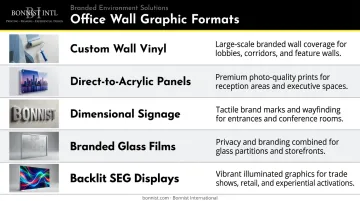
Each format serves a different spatial and cultural function. The right combination — chosen by location, audience, and intent — is what separates a visually interesting office from one that actively shapes how people feel about working there.
Key Ways Office Wall Graphics Improve Company Culture
The benefits below connect to outcomes business leaders actively track: engagement scores, retention rates, productivity, and first-impression impact on clients and candidates.
They Make Company Values a Daily, Visible Reality
Most employees can recall a company's mission statement right after joining. Within months, that connection fades as day-to-day work takes over. Office wall graphics interrupt that drift — not by demanding active attention, but by keeping values in passive, constant view.
In practice, this looks like:
- A mission statement rendered at architectural scale in the main corridor
- Core values displayed across a collaborative hub where teams gather
- Brand story visualized in the lobby, seen by every visitor and every employee who walks in
Research by Qualtrics found that 46% of workers have considered leaving a job due to a mismatch between their personal values and their company's values. Yet only 23% of U.S. employees strongly agree they can apply their organization's values to their work every day, according to Gallup. The gap between having values and employees feeling those values is enormous — and the physical environment is one of the most direct ways to close it.
SHRM's 2024 workplace culture report reinforces the stakes: workers in positive organizational cultures are nearly 4x more likely to stay with their current employer. When your walls reflect the culture you're building, that culture becomes something employees experience rather than just read about.
This matters most for:
- Companies scaling rapidly and onboarding new hires continuously
- Organizations undergoing rebrands or cultural shifts
- Multi-location businesses that need consistent identity across all sites
They Boost Employee Morale, Engagement, and Productivity
The physical environment employees inhabit every day has a direct psychological impact on how they feel about their work. A 2022 peer-reviewed study of 314 employees found that workplace environment alone corresponded with a 0.55-unit change in employee performance for every one-unit improvement — and that environment, achievement-striving ability, and commitment together explained 63% of the variation in employee performance.
A 2023 systematic review confirmed that nature exposure during working time has restorative effects for workers — biophilic design elements, including nature imagery in wall graphics, reduce stress even without access to actual outdoor spaces. Only 14% of employees want a corporate-feeling workplace, while 36% prefer workspaces with greenery, according to Gensler's 2025 Global Workplace Survey.
Wall graphics create this effect through:
- Vibrant imagery that energizes low-energy spaces
- Nature and outdoor visuals that reduce cortisol and mental fatigue
- Purposeful design that signals the company invests in the employee's daily experience
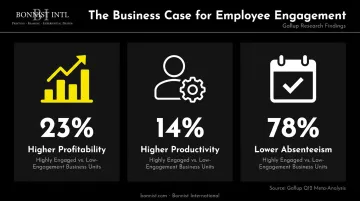
Gallup's Q12 Meta-Analysis reports that highly engaged business units show 23% higher profitability, 14% higher productivity, and 78% lower absenteeism compared to low-engagement units. Wall graphics alone won't drive those numbers, but they provide persistent, ambient reinforcement of the conditions that do.
Best applied when:
- High-pressure or high-volume office environments
- Facilities without natural light or outdoor views
- Companies emerging from low morale or significant organizational change
They Strengthen Brand Identity for Every Visitor Who Enters
Office wall graphics serve a dual audience. Employees experience the environment daily. External visitors — clients, partners, and job candidates — form rapid impressions the moment they walk in.
Gensler's 2025 Global Workplace Survey found that 90% of employees who like their workspace are proud to work for their company, compared to just 47% among those who feel disconnected from it. That pride shapes how employees represent the company to clients and recruits.
A visually branded office communicates credibility that no pitch deck fully replicates. A values wall executed with care signals those values are genuine. A generic or empty office signals the opposite: that a gap exists between what the company says and what it actually invests in.
KPIs affected by this:
- Client first-impression quality and meeting outcomes
- Job candidate pipeline quality in competitive hiring markets
- Employer brand perception among recruits and partners
Bonnist International has completed corporate office branding projects where brand impression was the stated priority — including direct-to-acrylic wall art installations for a major sports and entertainment company, and Dusted Crystal vinyl graphics throughout the NYCFC headquarters. In both cases, the documented outcomes included enhanced visitor experience, elevated employee pride, and reinforced organizational identity embedded into the physical workspace.
Particularly valuable for:
- Companies in competitive hiring markets where candidate experience matters
- Client-facing offices where first impressions influence deals
- Organizations building or refreshing their employer brand
What Happens When Your Office Walls Say Nothing
A blank or generic office environment carries a real cost — one that shows up in retention data and engagement scores long before it appears on any budget spreadsheet.
Only 26% of workers strongly agree that their current workplace helps them do their best work, per Gensler's 2025 survey. For employees in that majority, the daily experience of working in an unbranded, generic space gradually erodes their connection to the organization's identity. Company culture ends up confined to onboarding decks and all-hands slides — nowhere employees can actually see it.
The talent consequences are direct:
- New hires take longer to feel integrated when the environment provides no ambient orientation to who the company is
- Employees who feel disconnected from their workplace are nearly half as likely to feel proud working there
- Voluntary turnover costs U.S. businesses an estimated $1 trillion annually, with replacement costs ranging from 0.5x to 2x an employee's annual salary, according to Gallup
That erosion doesn't stay internal. For clients and candidates, the impression problem surfaces the moment they walk through the door. A generic, unbranded lobby signals disorganization before anyone shakes hands — and that first read can quietly undercut the credibility of everything discussed in the meeting that follows.
How to Plan and Implement Office Wall Graphics Effectively
Effective office wall graphics start with intentional planning — not with picking imagery and covering walls.
Map Cultural Intent to Physical Zones
Each area of an office serves a different cultural function. The graphics in each zone should serve that function specifically:
| Office Zone | Cultural Function | Graphic Approach |
|---|---|---|
| Lobby & Reception | External brand identity, first impression | Dimensional signage, bold branded panels |
| Corridors & Hallways | Ongoing brand storytelling | Direct-to-acrylic art, mission/values displays |
| Collaborative Hubs | Values like teamwork and innovation | Energizing imagery, cultural messaging |
| Conference Rooms | Professional credibility | Branded glass films, frosted graphics |
| Common Areas | Employee recognition, connection | Recognition elements, company history |
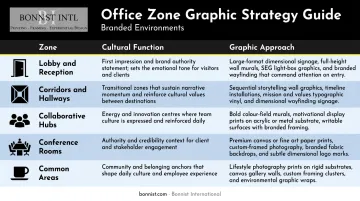
A lobby needs to communicate brand authority. A collaborative hub needs to energize the people working in it. Those are different jobs — and they require different graphic approaches.
Match Execution Quality to Cultural Intent
The physical quality of materials, printing, and installation is inseparable from the cultural message being delivered. A values statement printed on low-quality vinyl, misaligned on the wall, signals that the values aren't taken seriously. It actively undermines the intent.
This is where an experienced full-service partner makes a measurable difference. Bonnist International manages the complete process from design concept through fabrication and professional installation, with 33 years of corporate environment work behind them. That continuity prevents the quality gaps that come from coordinating separate design and installation vendors.
Design for Cultural Evolution from the Start
Companies rebrand. Values get refined. Teams grow. Office wall graphics don't need to be a permanent, static decision — and they shouldn't be treated as one.
Materials like printed wall vinyl, SEG fabric displays, and glass films can be updated without major disruption or construction. Quick-change frame systems allow rotating displays for employee recognition, seasonal messaging, or updated cultural content. Planning for this flexibility from the start makes future updates significantly more cost-effective.
Frequently Asked Questions
How does office design affect company culture?
Office design shapes culture by turning company values into something employees see and feel every day. The visual environment directly influences mood, sense of belonging, and connection to the brand — in ways that emails and town halls simply can't sustain on their own.
What's the best way to improve a company's work culture?
Culture improves through multiple reinforcing channels — leadership behavior, hiring practices, communication, and the physical environment. Wall graphics and branded spaces give culture a tangible, always-on presence that periodic town halls and emails cannot replicate.
Do office wall graphics really improve employee retention?
Research shows workers in positive organizational cultures are nearly 4x more likely to stay, and employees whose values align with their company's are significantly more likely to recommend their employer. Wall graphics keep that alignment visible every day — a constant visual reminder of shared purpose rather than something revisited only at all-hands meetings.
What types of wall graphics work best for corporate offices?
The right choice depends on the cultural role of each space:
- Lobbies and corridors: large-scale murals and dimensional signage
- Collaborative areas: mission and values displays
- Common spaces: company history timelines and employee recognition content
Matching the graphic type to how each area is used makes the biggest difference.
Can office wall graphics be updated as the company evolves?
Modern materials — printed vinyl, SEG fabric displays, glass films — allow graphics to be replaced or updated without damaging walls or halting operations. Planning for this flexibility from the start, through replaceable materials and modular display systems, makes future updates far more cost-effective.
How long do office wall graphics typically last?
Commercial-grade interior vinyl wall graphics typically last 2–5 years, based on product specifications from manufacturers including 3M, Avery Dennison, General Formulations, and Mactac. Actual lifespan depends on material grade, wall substrate, surface preparation, environmental conditions, and installation quality — professional installation is the primary factor in maximizing longevity.