The answer is experiential fabrication: the discipline that merges design, storytelling, and skilled craftsmanship to turn physical spaces into emotional journeys.
As audiences grow increasingly resistant to passive advertising, brands that want to be remembered — not just seen — are investing in environments that do the heavy lifting. This article breaks down what experiential fabrication is, why it works psychologically, how it applies across industries, and why the business case for it is stronger than ever.
Key Takeaways
- Experiential fabrication transforms physical spaces into brand stories through custom graphics, dimensional elements, and immersive installations
- Emotionally resonant environments are retained longer than passive media, according to memory and sensory research
- Industries served include sports venues, hotels, corporate offices, and retail pop-ups — each with distinct engagement goals
- According to EventTrack 2026, 61% of consumers are more inclined to purchase after an experiential event
- Choosing the right fabrication partner means finding one with end-to-end capability and a story-first philosophy
What Is Experiential Fabrication?
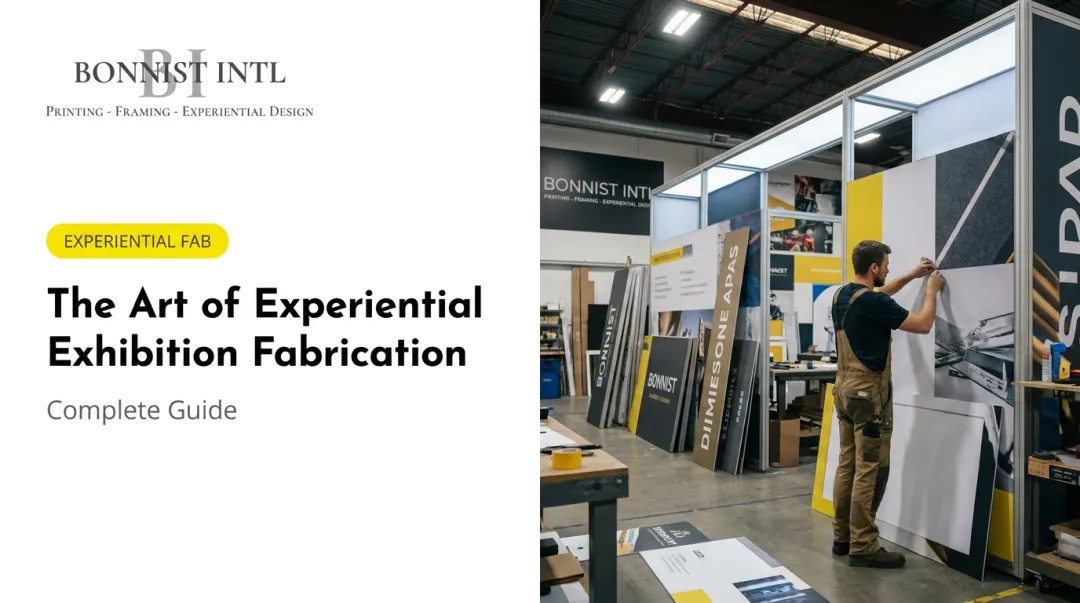
Experiential fabrication is the process of designing, engineering, and building custom physical environments (large-format graphics, sculptural displays, branded installations, dimensional signage, murals) that immerse audiences in a brand's story rather than simply presenting information.
The distinction from conventional signage or décor matters. Standard approaches prioritize utility and aesthetics. Experiential fabrication prioritizes emotional impact, narrative cohesion, and active audience participation. A directional sign tells you where to go. An experiential environment makes you feel something the moment you arrive.
Scale varies enormously: from a single hero installation in a lobby to a full venue transformation spanning concourses, suites, locker rooms, and training facilities. The intent stays constant: give every visitor a reason to feel connected to the brand, not just aware of it.
What "Inspired Fabrication" Means in Practice
Bonnist International, a New York-based B2B fabrication company with 33 years of experience, built their approach around a concept they call "Inspired Fabrication": every fabricated element traces back to an emotionally resonant source, such as a team's history, a hotel's locale, or a company's founding story.
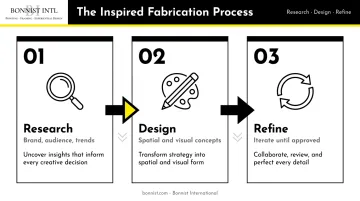
Their process follows three stages:
- Research — Investigate the brand, competitive landscape, target audience, and design trends before any creative work begins
- Design — Translate research insights into spatial and visual concepts that reflect the brand's personality
- Refine — Iterate based on client feedback until the concept is approved for production
The building blocks that make fabrication truly "experiential":
- Multisensory engagement — visual scale, texture, and light working together to create physical impact
- Narrative wayfinding — design that guides visitors through a story, not just a space
- Shareable moments — installations that invite interaction, photography, and organic social reach
The Psychology Behind Why Immersive Experiences Work
Physical environments that carry emotional weight aren't just more pleasant — they're genuinely more memorable. Research from Cahill and McGaugh established that stress hormones and the amygdaloid complex play key roles in consolidating emotionally charged memories, while fMRI studies by Murty et al. show that emotionally salient information is remembered with greater accuracy and vividness than neutral information.
For brands, the takeaway is direct: a well-crafted immersive environment outlasts any banner ad in a visitor's mind.
From Observer to Participant
Experiential environments shift the audience's role. Instead of being marketed at, visitors become active participants in a brand story. When someone physically moves through a space, reads its story on the walls, and photographs an installation to share with followers, they develop a sense of ownership over the experience.
That ownership drives deeper brand affinity.
There's a social dimension to this too. According to Stackla's consumer research, 79% of consumers say user-generated content highly impacts purchase decisions, and UGC is viewed as three times more authentic than brand-created content. Environments designed with shareable moments — a striking mural, a photo-worthy dimensional installation — generate organic reach that extends the experience well beyond the physical location.
The Loyalty Connection
Experiences that trigger positive emotions create associations that influence future behavior:
- Longer dwell times in physical spaces
- Higher rates of repeat visits
- Increased merchandise and concession spend
- Stronger word-of-mouth referrals
This is why experiential fabrication is a revenue-relevant investment, not just an aesthetic one. The environment delivers impact on every visitor, continuously, without incremental media spend.
Experiential Fabrication Across Industries
The principles stay consistent. The application looks different depending on the audience, the space, and the brand's objectives — and that versatility is precisely what makes it effective across sectors.
Sports Venues and Arenas
Sports environments use large-scale graphics, championship timelines, player tributes, and sponsor integration to transform game day into a full brand encounter. Deloitte identifies stadium atmosphere as one of the "Core Four" fan expectations — alongside safety, seat view, and game quality — and notes these four factors are 50% more important than other stadium attributes combined.
Bonnist International's work demonstrates this in practice. For NYCFC, they produced branded Dusted Crystal vinyl logo graphics across headquarters glass doors and windows, plus large-format co-branded windscreens (Etihad Airways + NYCFC) running 8 feet high and 35 feet long along the training facility perimeter. At MetLife Stadium, they transformed VIP suites with Thursday Night Football custom wall vinyl and created a Prime Sports branded lounge using repositionable vinyl featuring Eagles and Giants imagery.
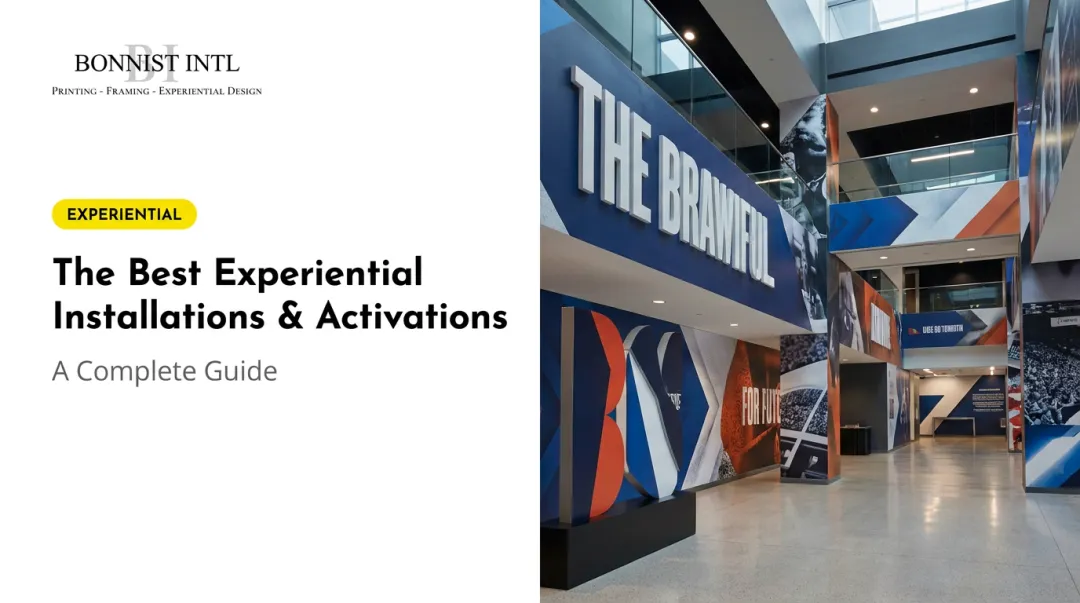
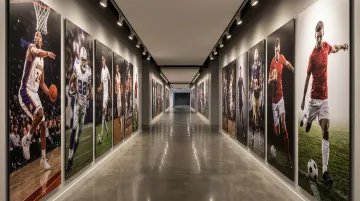
At MSG, second-surface acrylic panels of basketball action photography along a facility corridor turned a functional hallway into a gallery-quality brand experience — proof that even transitional spaces can carry the brand story forward.
Hospitality and Hotels
Hotel design quality directly predicts guest satisfaction and repeat bookings — hospitality research consistently links physical environment quality to both. When every touchpoint from lobby to guest room tells a coherent story, the property becomes a destination in itself, not just a place to sleep.
Bonnist's work for MSocial Hotel NYC illustrates the scale this can reach. Their design team built a custom signature artwork mural from scratch — featuring the Charging Bull, Wall Street signage, and Broadway references — and printed it on Dreamscape wallpaper installed across all 450+ guest rooms. The result: a property-wide narrative tied directly to the hotel's downtown Manhattan identity, executed consistently at scale and delivered on time.
That kind of cohesive environment also drives organic social sharing — guests photograph and post installations that carry the brand's story far beyond the property itself.
Corporate Offices and Commercial Spaces
Corporate environments increasingly use branded installations, heritage walls, and custom art programs to do two things simultaneously: reinforce company culture for employees and communicate credibility to visiting clients.
Gensler's workplace research found that employees with a great workplace experience are 5x more likely to experiment with new ways of working and 2x as likely to feel proud of their company. Physical space shapes behavior and belonging.
Bonnist's corporate work turns workspaces into statements of identity:
- Dimensional lobby signage for Consumer Reports
- Dusted Crystal glass branding for NYCFC headquarters
- Direct-to-acrylic corridor art programs for major sports and entertainment organizations
E-Commerce and Retail
For e-commerce brands building physical touchpoints — pop-ups, showrooms, retail partner displays — experiential fabrication bridges the gap between digital identity and tangible presence. For many customers, a pop-up or showroom is their first real encounter with the brand. Research consistently shows that pop-up store design dimensions, including signage, style, and layout, positively affect brand attitude and purchase intention.
Bonnist helps digital-native brands make that transition confidently:
- Custom point-of-purchase displays built for high-traffic retail environments
- Visual merchandising support that guides customers toward purchase decisions
- Branded retail environments designed to make online brands feel real and trustworthy in person
From Vision to Reality: How Experiential Fabrication Works
The process starts with discovery — understanding the brand's story, audience, space constraints, and objectives — before a single design decision is made. This research foundation is what prevents generic output.
From there, the workflow moves through:
- Concept development — translating narrative into spatial and visual language
- Material selection — choosing substrates, fabrication methods, and finishes appropriate to the environment and durability requirements
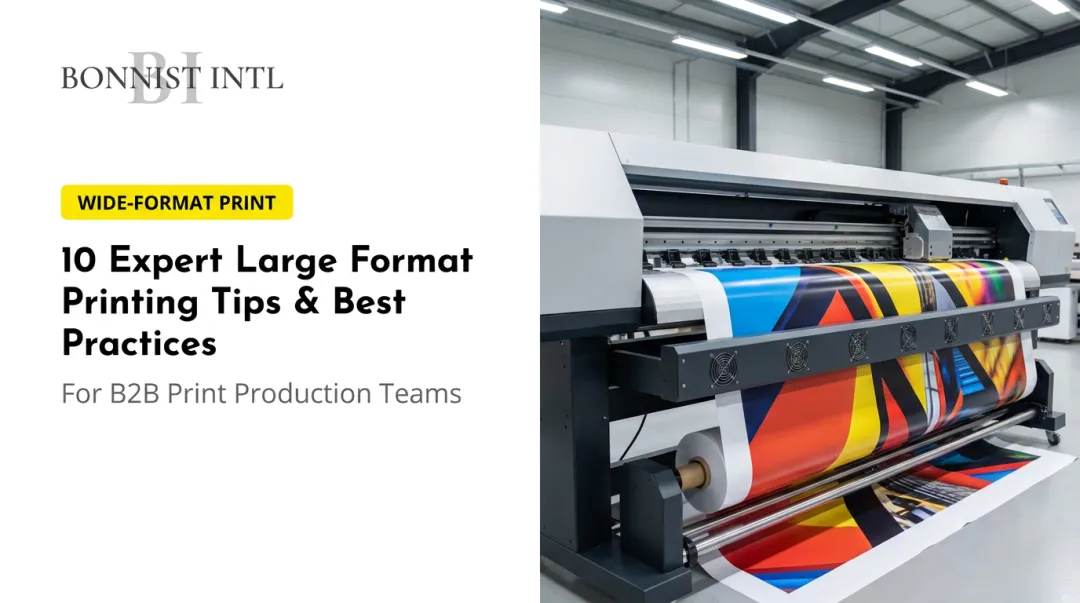
- Production — using a combination of artisanal craftsmanship and modern technology (CNC machining, laser cutting, 3D printing, wide-format printing, SEG systems, direct-to-substrate printing)
- Installation — delivering and integrating finished elements with precision, on schedule
What makes this process distinct is how creative vision, material expertise, and structural precision depend on each other at every stage. The output reflects that integration — and it can take more than one form within a single project.
Permanent vs. Modular: Two Modes, One Project
Fabrication outputs span two modes that often coexist:
- Permanent brand anchors — stadium murals, lobby sculptures, direct-to-acrylic corridor art, Dreamscape wallpaper programs
- Modular and seasonal installations — event barrier covers, repositionable suite vinyl, SEG displays with swappable graphics
Bonnist's Thursday Night Football barrier cover program — over 40 custom-printed, weather-resistant fabric barriers for a nationally televised event — and MSocial's 450-room permanent wallpaper installation represent both ends of this spectrum within the same company's portfolio.
The Business Case: Why Smart Brands Invest in Experiential Fabrication
The outcomes that make experiential fabrication a strategic investment rather than a discretionary cost:
- Higher purchase intent — 61% of consumers are more inclined to purchase after an experiential event (EventTrack 2026)
- Increased dwell time — emotional responses to physical environments predict extra time spent and incremental spending, independent of price and merchandise perceptions
- Organic social reach — shareable environments generate UGC that is 3x more trusted than brand content
- Stronger sponsor ROI — multi-zone placement (perimeter, suites, media areas, corridors) gives sponsors measurable, broadcast-visible exposure
- Employee morale — enriched physical workplaces improve productivity, pride, and engagement
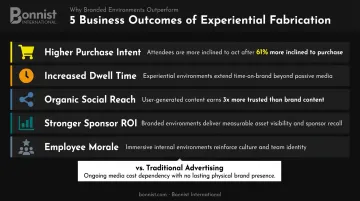
Contrast this with traditional advertising: a recurring cost that stops generating impressions the moment media spend stops. A well-executed physical environment — a permanent mural, a dimensional lobby installation, a branded corridor — generates emotional associations every day, at no additional media cost.
When audiences are saturated with digital ads, a physical environment that tells a specific, authentic story does something a banner ad simply cannot: it creates a memory. Bonnist International brings 33 years of fabrication experience across sports arenas, hotel properties, and corporate headquarters — managing every step from concept through installation for brands ready to make that shift.
Frequently Asked Questions
What is experiential fabrication?
Experiential fabrication is the process of designing and building custom physical environments — installations, graphics, displays, and dimensional elements — that immerse audiences in a brand's story and create a sensory journey visitors remember long after they leave.
What is an example of fabrication in an experiential context?
A stadium tunnel lined with large-format championship imagery and custom dimensional signage is one example. A hotel with 450+ guest rooms featuring custom-designed murals tied to the property's city and neighborhood is another, each designed to make visitors feel genuinely connected to the brand.
What does an experiential designer do?
An experiential designer translates a brand's narrative into spatial and visual concepts — determining how a visitor will move through, feel within, and respond to a physical environment. They collaborate closely with fabricators, artists, and engineers to ensure those concepts translate into built reality.
What framework guides experiential marketing?
Bernd Schmitt's peer-reviewed framework identifies five Strategic Experiential Modules: SENSE, FEEL, THINK, ACT, and RELATE. Experiential fabrication sits at the intersection of SENSE and FEEL, giving concepts physical form through materials, scale, and craft to build genuine audience connection.
How does experiential fabrication differ from traditional marketing?
Traditional marketing is passive: audiences receive a message. Experiential fabrication makes them active participants in a brand story, and emotional memories consistently drive stronger recall, loyalty, and word-of-mouth than broadcast advertising delivers.
How do I choose the right experiential fabrication partner?
Look for demonstrated experience across your industry, an end-to-end capability from concept through installation, a portfolio of relevant large-scale work, and a client-first approach that begins with understanding your specific brand story and audience before any design decisions are made.