
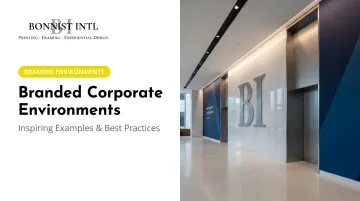
This post covers what branded corporate environments are, why they matter for business, the core design elements that make them work, and real-world examples from corporate offices, sports venues, and hospitality properties. Whether you're planning a single lobby refresh or a multi-floor headquarters transformation, the principles here apply.
Key Takeaways
- Branded environments go far beyond logos — every material, lighting choice, and surface works together to communicate identity
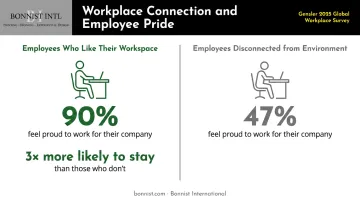
- Workspace pride is measurable: 90% of employees who like their workspace say they're proud to work for their company, versus 47% among those who feel disconnected
- Sports venues, corporate offices, and hotels all use the same core design toolkit — what changes is the story being told
- Custom fabrication and dimensional elements are what separate memorable spaces from generic ones
- Single-source partners — handling design, fabrication, and installation — produce more cohesive results than multiple disconnected vendors
What Are Branded Corporate Environments?
A branded corporate environment is a physical space intentionally designed to communicate a company's identity, values, and story through every design decision — from layout and lighting to materials, graphics, signage, and custom fabrication.
That distinction matters. Basic office decoration involves isolated elements: a name on a reception wall, generic art to fill a blank surface, a directional sign in a hallway. These may look professional in isolation. They don't tell a story.
The Difference Between Decoration and Environmental Branding
A true branded environment creates an immersive, cohesive experience where every element reinforces a unified message. The goal is to transform a space so that employees, clients, and visitors feel the brand the moment they enter.
This practice is called experiential design: the deliberate combination of materiality, color, texture, scale, and interactive touchpoints to make visitors not just see the brand but experience it physically. The warmth of reclaimed wood or the scale of a 30-foot photographic mural — these choices register emotionally before they register intellectually.
Which Spaces Qualify?
Branded environments span far more than corporate headquarters:
- Office lobbies, hallways, and collaborative spaces
- Professional sports training facilities and locker rooms
- Hotel lobbies, corridors, and guest rooms
- Stadium concourses and VIP suites
- Senior living communities
- Retail showrooms and event spaces
Any sector where physical space shapes perception is a candidate for this approach.
Why Branded Corporate Environments Matter for Business
First Impressions Set the Entire Relationship
A well-branded space communicates professionalism and identity instantly. Before a client meeting starts, before a job candidate sits down, the space has already delivered a message. That message either builds confidence or raises questions. For sports venues, the same logic applies to fans and sponsors — a generic stadium corridor signals that an organization isn't paying attention.
Employee Morale and Retention
The data here is direct. According to Gensler's 2025 Global Workplace Survey, 90% of employees who like their workspace say they are proud to work for their company, compared with just 47% among those who feel disconnected from their environment. The same research found that employees in great workplaces are nearly 3x more likely to stay with their company.
Pride and retention aren't soft metrics — they translate directly to lower hiring costs, stronger culture, and sustained performance gains.
Customer Trust and Brand Consistency
Physical space is a brand touchpoint like any other — and consistency across touchpoints matters commercially. Research from Lucidpress found that companies with consistent branding can see up to a 33% increase in revenue. When a physical space feels authentic to a brand's story, clients and partners feel the organization is credible and coherent.
Sponsor and Partner ROI in Sports Venues
For sports and events clients, branded environments function as active marketing assets. Strategically placed branding — perimeter windscreens, barrier covers, press backdrops, VIP suite vinyl — reaches live audiences, broadcast viewers, and social media simultaneously. Bonnist International has executed this across venues including NYCFC, MetLife Stadium, and MSG — including branded windscreens carrying Etihad Airways sponsorship that put partner logos in front of live crowds, broadcast cameras, and social feeds at the same time.
Social Shareability as Organic Marketing
Visually distinctive spaces generate their own distribution. A 2024 MDPI study on hotel content found that over 60% of travelers share content from their trips on social media, and that posts combining physical hotel attributes with people averaged 319 likes per post — nearly three times higher than static images. A well-designed space, in other words, earns its own audience.
Key Elements That Define a Powerful Branded Corporate Environment
Color, Typography, and Graphic Systems
Consistent color palettes and typographic language applied across walls, floors, wayfinding, and signage create visual cohesion that reinforces brand recognition throughout the entire space. When deployed with enough discipline, any single element — pulled from context — still reads as unmistakably that brand.
Large-Scale Graphics, Murals, and Photography
Oversized visual storytelling transforms blank surfaces into narrative moments. Heritage walls, athlete photography, brand history timelines, and custom murals connect visitors emotionally to an organization in ways that text-on-a-wall cannot.
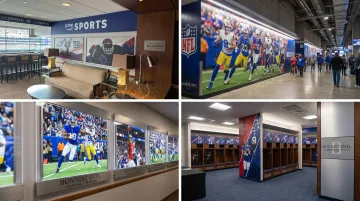
At Madison Square Garden, Bonnist produced dynamic basketball action photography on glossy second-surface acrylic panels installed throughout facility corridors — an installation that serves both motivational and identity purposes for athletes, staff, and visitors. The scale and material choice are inseparable from the effect.
Custom Fabrication and Dimensional Elements
This is where memorable branded environments diverge from generic ones. Purpose-built physical installations — dimensional logos, brass lettering, backlit SEG displays, custom lobby signage — create depth and presence that flat printing cannot replicate.
For the Etihad Park Experience Center, Bonnist fabricated dimensional gold metallic lettering mounted against a textured tile wall — communicating brand prestige before anyone read a word. For Consumer Reports, dimensional "CR" lettering anchored the reception area with authority.
These elements work because they carry physical weight. Tactile sophistication signals craft and intentionality in a way no printed graphic can replicate.
Bonnist's production capabilities — CNC machining, laser cutting, 3D printing, direct-to-substrate printing on acrylic, metal, and PVC — make this level of fabrication achievable across project scales.
Lighting Strategy
Thoughtful lighting reinforces brand mood, highlights focal points, and creates distinct spatial experiences across a single building. Warm light in collaboration zones reads differently than cooler light in focused work areas, and both serve the brand's story when deployed with intent. Backlighting SEG fabric displays, for example, transforms a corridor installation from a static graphic into an immersive visual statement.
Materials as Brand Storytelling
Material choices communicate values before anyone reads a word. Consider the contrast:
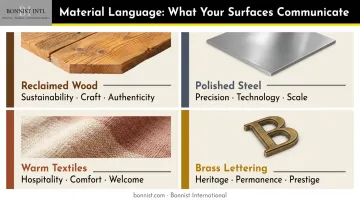
| Material | Brand Story It Tells |
|---|---|
| Reclaimed wood | Sustainability, craft, authenticity |
| Polished steel | Precision, technology, scale |
| Warm textiles | Hospitality, comfort, welcome |
| Brass lettering | Heritage, permanence, prestige |
Gensler has documented that resilient materials can carry history, geography, and values — and cited Nike using recycled sneakers in furniture and flooring as a material choice that reinforces their values while creating something unique to the brand. Etsy's headquarters achieved the same effect with reclaimed water tower wood, salvaged industrial doors, and 750+ maker-crafted pieces. Each material decision added a layer of proof — that the brand's stated values were built into the walls, not just printed on them.
Inspiring Examples Across Industries
These examples span sectors, but the underlying principles — intentional material choices, large-scale visual storytelling, dimensional elements, cohesive graphic systems — run through all of them.
Corporate Offices
Etsy, Brooklyn, NY — Gensler's 200,000-square-foot Etsy headquarters embedded the maker marketplace's values into every surface. Reclaimed water tower wood, NYC scaffolding lumber, salvaged industrial doors, and over 750 pieces of custom furniture and lighting from local studios turned the space into a physical argument for the brand's identity. The environment achieved Living Building Challenge Petal Certification, with the material choices doing the storytelling work.
LinkedIn — Gensler developed a full Environmental Graphic Design program for LinkedIn's global offices. In Omaha, the office uses a "going against the current" concept tied to the city's name, with local references including the Elkhorn River, reused corn husk art installations, and motivational stair-tread graphics.
In New York, Acrylicize created bespoke graphics referencing Central Park, jazz culture, and NYC food — with commissions from local artists. Each location feels both unmistakably LinkedIn and genuinely local.
Nike NYC Headquarters — STUDIOS Architecture designed Nike's 150,000-square-foot, six-floor New York headquarters as a sports environment first and an office second. Stadium bleachers, a 4,000-square-foot regulation basketball court, athlete photography including Michael Jordan, shoe-sole ceiling tile patterns, and a Volkswagen minibus tribute to Nike's early history create an energized, purpose-driven workplace that recruits, inspires, and retains talent through the environment itself.
Sports Venues and Arenas
University of Oklahoma Barry Switzer Center — The 132,000-square-foot complex goes beyond a standard athletic facility by embedding Oklahoma football history throughout the space. The lobby received dedicated brand activation work from Populous, and the facility's design pays homage to the program's heritage through trophy displays and memorabilia installations — making the environment motivational rather than merely functional.
Adidas Company Gym, Herzogenaurach — Büro Uebele covered the gym's walls in supergraphics and illuminated numerals with layered meaning: a massive lit 54 on the ceiling references Germany's 1954 World Cup victory; the number 13 references Gerd Müller. Reported on by Designboom and awarded by Red Dot, the installation shows that sports branding principles translate directly into corporate culture spaces — when the numbers mean something, the environment does too.
NYCFC, MetLife Stadium, and MSG — Bonnist International has built branded environments for all three. For NYCFC, custom Dusted Crystal vinyl applied to glass throughout the headquarters created a consistent, professional environment that embedded club identity into every surface. At MetLife Stadium, custom suite vinyl for Thursday Night Football created polished, event-specific hospitality spaces. For MSG, second-surface acrylic basketball photography in facility corridors combined inspirational imagery with fine-art print production.
Hospitality and Hotels
Jackalope Hotel, Mornington Peninsula, Australia — SEGD documents this property as one of the most complete examples of environmental storytelling in hospitality. The design brief centered on an "otherworldly experience rich with narrative and imagination," with alchemy and winemaking themes running from lobby to guest room.
The detail work is what makes it stick:
- Alchemical symbols integrated into room numbers
- 10,000 suspended amber glass bulbs in the Doot Doot Doot restaurant referencing fermentation
- Neon astrological formulas on corridor ceilings
- Gold foil external wayfinding
Every element earns its place — guests photograph the space because the narrative is embedded in the architecture itself.
MSocial Hotel NYC — Bonnist produced and installed custom Dreamscape wallpaper across 450+ guest rooms, using a collage of the Charging Bull, Wall Street signage, and Broadway to embed New York City's identity into every room. The project required precision design, durable materials suited to long-term hospitality use, and coordinated installation across the entire property — delivered on time for the rebrand rollout.
Best Practices for Planning and Executing Your Branded Corporate Environment
Start with Brand Discovery, Not a Mood Board
Successful branded environments begin with interviews, competitive analysis, audience research, and a clear brief. What story does this space need to tell? Who will experience it, and what should they feel? Material and color decisions made before these questions are answered produce visually polished spaces that fail to reinforce the brand.
Bonnist's process starts here deliberately — researching brand identity, target audience, and competitive context before a single design concept is developed.
Work with Partners Who Own the Full Process
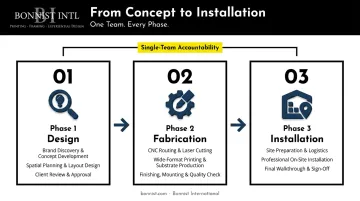
The most common breakdown in branded environment projects happens at handoffs: between designer and fabricator, between fabricator and installer. Each transition introduces the risk that design intent gets diluted, timelines slip, or quality standards diverge.
An experienced end-to-end partner manages design, fabrication, and installation as a single accountable process. Bonnist's clients, from TNF at MetLife Stadium to MSocial Hotel's 450+ room rollout, benefit from this directly. The same team that designs the space also builds and installs it, which means what gets designed is what gets delivered.
Build in Scalability from the Start
Branded environments need to evolve. New sponsors, seasonal campaigns, updated messaging — a space designed with no update mechanism becomes expensive to maintain. Plan for this upfront:
- Modular graphic systems (SEG displays, tension fabric displays, quick-change frames) allow content to refresh without replacing infrastructure
- Durable substrates (vinyl, mesh, Dreamscape wallpaper) support periodic updates at manageable cost
- Documented graphic standards ensure new elements integrate cleanly with existing installations
Frequently Asked Questions
What are branded corporate environments?
Branded corporate environments are physical spaces — offices, venues, hospitality properties, or retail locations — intentionally designed using graphics, materials, lighting, and custom fabrication to reflect a company's identity, values, and story. The goal is an immersive experience where every design element works together, rather than decorative afterthoughts.
What are examples of branded corporate environments?
Examples span every sector: Nike's New York headquarters uses athlete installations across 150,000 square feet to create a purpose-driven workplace; LinkedIn embeds local cultural references and murals into global offices; and the University of Oklahoma Barry Switzer Center activates team heritage across 132,000 square feet. In hospitality, hotels like Jackalope carry narrative design from lobby to guest room.
What are the key elements of a branded corporate environment?
The core components are consistent color and graphic systems, large-scale murals or photography, custom dimensional elements (signage, brass lettering, backlit displays), strategic lighting, and material choices that communicate brand values tangibly. Every element should reinforce a single cohesive story.
How do branded environments impact employee engagement?
Gensler's 2025 Global Workplace Survey found that 90% of employees who like their workspace say they are proud to work for their company, compared with 47% among those who feel disconnected. Employees in great workplaces are also nearly 3x more likely to stay — linking physical environment quality directly to retention and morale.
How long does it take to design and install a branded corporate environment?
Timelines vary considerably by scope — a focused graphic installation may take a few weeks, while a multi-floor headquarters transformation typically spans several months across design, fabrication, and installation phases. Working with an end-to-end partner who manages all phases under one roof significantly reduces timeline risk at every handoff point.
How do I get started with a branded environment project?
Begin with a clear brief: define the story you want the space to tell, who will experience it, and what you want them to feel. Then work with a partner experienced in both brand strategy and physical production. Bonnist International can be reached at david@bonnist.com or 845-641-4864 to discuss your project.