
Introduction
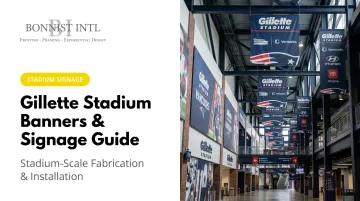
Walk into Gillette Stadium on game day and the signage tells the whole story before kickoff. Six Super Bowl championship banners flank the south facade. Sponsor graphics wrap tunnel entrances. Player murals line the concourse walls. Directional signage moves 65,000 fans to their seats without a hitch.
This guide covers both angles. For fans, it answers the key questions about Patriots championship banner history, including the 2017 facade expansion that created space for future titles. For stadium operators, sports marketers, and venue managers, it breaks down how elite signage systems are designed, planned, and executed at scale.
Key Takeaways
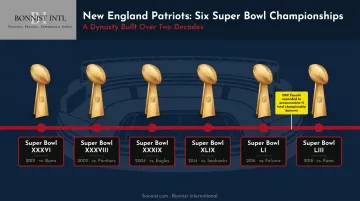
- The Patriots have 6 Super Bowl championship banners displayed at Gillette Stadium, representing wins in Super Bowls XXXVI, XXXVIII, XXXIX, XLIX, LI, and LIII
- After Super Bowl LI, the stadium required structural modifications to add a fifth banner; the reinforced system now holds up to 11
- Stadium signage spans five distinct categories: championship banners, permanent brand identity, sponsor displays, wayfinding, and event/seasonal graphics
- Large-format outdoor banners require material, structural, and graphic planning well before production begins
- Planning for expandable banner systems upfront prevents costly mid-season construction when venues need to add displays
The Patriots' Championship Banners at Gillette Stadium
How the Banner Program Started
Gillette Stadium opened in 2002. When the Patriots won Super Bowl XXXVI that same season, the banner program began with room to grow — or so it seemed. The original display placed four Super Bowl banners flanking the Gillette Stadium sign on the south side of the structure, a clean, symmetrical arrangement that worked well through four titles.
Then came Super Bowl LI.
The 2017 Space Crisis
After the Patriots' fifth championship win in February 2017, the franchise hit an unexpected wall. Robert Kraft told NFL.com on August 1, 2017: "We had no more room to put banners so we had to change the construction around."
The fix wasn't cosmetic. ESPN reported that the project involved moving a nearly 8,000-pound sign structure. The Gillette Stadium sign on the south end was raised and the entire display area was reconfigured to accommodate the Super Bowl LI banner.
When the dust settled, CBS Sports confirmed the redesigned system created room for up to 11 Super Bowl banners — space the organization explicitly planned for future titles.
Current Banner Count and Display
As of the 2024 NFL season, the Patriots have six Super Bowl championship banners at Gillette Stadium:
| Banner | Season | Opponent |
|---|---|---|
| Super Bowl XXXVI | 2001 | St. Louis Rams (20–17) |
| Super Bowl XXXVIII | 2003 | Carolina Panthers |
| Super Bowl XXXIX | 2004 | Philadelphia Eagles |
| Super Bowl XLIX | 2014 | Seattle Seahawks |
| Super Bowl LI | 2016 | Atlanta Falcons |
| Super Bowl LIII | 2018 | Los Angeles Rams |
The Ceremony Tradition
Banner reveals happen on opening night of each new NFL season — a ritual that reinforces franchise identity and builds fan excitement every year. The tradition has its quirks: before the official Super Bowl LIII banner was raised on September 8, 2019, a temporary "6X Champions" placeholder flag had already been hanging at the display location since May of that year.
The Full Signage Ecosystem at Gillette Stadium
Championship banners are one layer of a much larger visual system. A modern NFL venue like Gillette operates across five distinct signage categories, each serving a different function.
The Five Categories
| Category | Examples at Gillette |
|---|---|
| Championship/legacy banners | Super Bowl banners on south facade |
| Permanent brand identity | Exterior channel letters, end zone graphics, tunnel branding |
| Sponsor and advertising | Bud Light Beer Hall, DraftKings Sports Zone, JetBlue Landings |
| Wayfinding and safety | Entry monuments, directional signs, ADA signage |
| Event and seasonal graphics | Playoff installations, concerts, international events |
Permanent Brand Identity
Permanent brand identity signage defines the baseline visual language fans associate with a venue. At Gillette, this includes the Daktronics-installed channel lettering above the north end zone — 14 feet high by 108 feet wide — along with exterior facades, field-level graphics, and club-level environments.
Design Communications Ltd. also contributed a north end zone signage solution with bowl-side and plaza-side monumental signs featuring integrated LED technology. These installations aren't replaced seasonally — they anchor the venue's identity year-round.
Digital vs. Physical Signage
Gillette's 2023 Daktronics expansion added 47 LED displays totaling 48,500 square feet of digital canvas, including a north end zone display measuring 60 feet high by 370 feet wide. Screens deliver motion and real-time content — but physical banners deliver scale, texture, and permanence that a video board cannot replicate. The most effective stadium environments use both deliberately.
Event and Seasonal Graphics
Gillette operates as a multi-use venue — NFL games, concerts, international soccer matches, and college bowl games all cycle through. Each requires temporary signage that transforms the space without disturbing permanent installations. This is where modular, replaceable graphic systems earn their value.
Together, these five categories form a layered visual system — one where every element, from a 370-foot video board to a modular event banner, plays a defined role in the fan experience.
What Goes Into Designing Stadium-Scale Banners
Material Selection
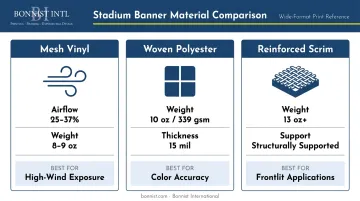
The materials used for large outdoor stadium banners aren't the same as standard printed vinyl. The stadium environment demands more:
- Mesh vinyl — Coated polyester scrim with perforations (typically 25–37% airflow) that reduce wind load on the banner surface. Ultraflex's Strip Mesh Plus runs 8 oz with 37% airflow; their UltraMesh Supreme is 9 oz with 25% airflow for closer viewing distances
- Woven polyester — Products like Aurora's Poly Banner Plus (10 oz / 339 gsm, 15 mil thick) offer durability and consistent color reproduction for temporary outdoor banners and arena environments
- Reinforced scrim — Heavier frontlit materials (13 oz and above) for banners where wind resistance comes from structural support rather than porosity
Every outdoor banner also needs UV resistance to prevent fading, heavy-duty grommet reinforcement at attachment points, and seam finishing that won't fail under sustained tension.
Structural and Mounting Considerations
Banner installations must account for:
- Wind load calculations — Governed by ASCE 7-16 Section 29.3 for solid signs, requiring site-specific data including risk category and basic wind speed
- Attachment point stress — Grommets and rigging hardware bear the full dynamic load of a banner in wind; failure here puts people at risk
- Existing architecture — The structure being attached to must have load-bearing capacity validated before installation begins
The Gillette 2017 project is the clearest illustration: adding a fifth banner required moving an 8,000-pound structure, not just hanging new hardware.
Graphic Design at Stadium Scale
What reads clearly at 10 feet looks very different at 100 feet. The International Sign Association recommends letters at least 1 inch tall for every 25 feet of viewing distance — meaning a banner readable from 200 feet needs 8-inch minimum letter heights. At stadium scale, that translates to letterforms measured in feet, not inches.
Color calibration matters too. A few principles that affect large-format output:
- Panel-to-panel consistency — Hues must match precisely across seams spanning the full banner width
- Monitor-to-output calibration — What looks correct on screen often needs adjustment when output spans 30 feet
- Viewing distance testing — Sponsor logos and type must read clearly from field-side distances, not just up close
Bonnist International has handled this full pipeline at venues including MetLife Stadium and MSG — from concept through structural coordination to final installation. Their NYCFC windscreen project required each panel to maintain sharp logo clarity at 8 feet high by 35 feet long, with Etihad Airways sponsor branding fully legible from field-side distances.
Sponsor and Commercial Signage at Gillette Stadium
The Naming Rights Relationship
Procter & Gamble holds Gillette Stadium's naming rights through the 2031 season, extending a relationship that began when the venue opened in 2002. The financial terms of the deal haven't been publicly disclosed, but the signage implications are visible across every major surface in the building — from the massive channel letters above the north end zone to branded areas including the Bud Light Celebration Beer Hall, DraftKings Sports Zone, Encore Boston Harbor Terrace, and JetBlue Landings.
This hierarchy — title partner at the top, category sponsors occupying named fan areas below — is standard at NFL venues and reflects how signage placement translates directly into commercial value.
How Placement Gets Valued
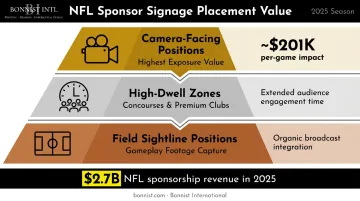
Sponsor signage isn't priced by square footage. It's priced by exposure value — and at NFL stadiums, that means:
- Camera-facing positions — Ribbon boards and field-level displays that appear in broadcast frames generate measurable media value. Sports Business Journal research estimated that NFL sponsors lost an average of $106,000 in exposure value per game without fans present, with Patriots partners facing a $201,000 hit in empty-venue scenarios
- High-dwell zones — Concourses, entry plazas, and premium clubs where fans spend significant time between plays
- Sight lines from the field — Positions visible from the playing surface itself, captured in gameplay footage
Balancing Commercial and Brand Needs
The practical challenge at a venue like Gillette is keeping sponsor graphics from fragmenting the stadium's visual identity. When third-party graphics follow different design standards than the Patriots' brand system, the overall environment reads as cluttered rather than cohesive.
Well-integrated sponsor signage works with venue aesthetics — not against it. That means:
- Color harmony — sponsor palettes that complement, not clash with, the venue's brand system
- Typographic consistency — fonts and sizing that align with existing environmental graphics
- Spatial hierarchy — placement that respects sightlines and doesn't compete with wayfinding
This isn't a creative preference; it's a commercial one. Sponsors get measurably more value from placements that feel native to the environment.
NFL team sponsorship revenue reached $2.7 billion in 2025, up 8% year-over-year, with more than 440 new brands entering the league. With that many brands competing for premium positions, the quality and integration of signage has become a deciding factor in whether partnerships get renewed — or replaced.
Planning Your Own Stadium Banner Program: Lessons from Gillette
Plan for Growth, Not Just Today
The Patriots' 2017 situation is the clearest possible case study in what happens when banner infrastructure isn't planned for success. Four banners fit the original display. The fifth required moving an 8,000-pound structure. The lesson isn't specific to championship banners — it applies to any venue-scale display program.
When planning initial installations, build in:
- Structural capacity beyond current inventory
- Visual slots reserved for future additions
- Attachment points that can accommodate additional panels without reconfiguration
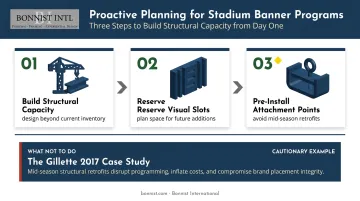
The cost of doing this upfront is minimal. The cost of retrofitting mid-season — as Gillette demonstrated — is substantial.
Build a Modular System
A modular banner system allows individual panels to be replaced, added, or updated without structural intervention. This matters across all five signage categories:
- Championship banners can be added as titles are won
- Sponsor graphics can rotate as partnerships change
- Event graphics can be swapped between the NFL season, concerts, and international events
- Quick-change frames and tension fabric systems (like SEG displays) make graphic replacement an operational task rather than a construction project
This is the approach Bonnist International has applied across projects for MetLife Stadium, MSG, and NYCFC. Their barrier cover and windscreen work uses weather-resistant fabric systems that can be updated event-to-event without altering any underlying structure.
Work With Partners Who Manage the Full Process
Fragmented vendor management is one of the most common operational problems in stadium signage. When design, production, structural coordination, and installation are handled by different vendors, gaps in coordination are nearly inevitable.
For venues planning a new banner program, the most practical recommendation is to work with fabrication partners who own the full pipeline — from architectural assessment and material specification through graphic production and installation. Bonnist International has managed this kind of integrated work across sports venues for over 30 years, handling every phase so operators aren't chasing multiple contractors against event-driven deadlines.
Frequently Asked Questions
How many championship banners do the New England Patriots have at Gillette Stadium?
The Patriots currently display six Super Bowl championship banners at Gillette Stadium, representing wins in Super Bowls XXXVI, XXXVIII, XXXIX, XLIX, LI, and LIII. Following 2017 construction, the display system was expanded to accommodate up to 11 banners total.
How big are the Super Bowl banners at Gillette Stadium?
Exact dimensions haven't been publicly confirmed, but the scale is significant. The 2017 retrofit required moving a nearly 8,000-pound sign structure to create space — indicating these are multi-story installations with substantial structural demands.
What types of signage does Gillette Stadium have beyond championship banners?
Gillette's signage ecosystem includes permanent brand identity graphics, named sponsor areas (Bud Light Beer Hall, DraftKings Sports Zone), a 48,500-square-foot digital LED display network, wayfinding and safety signage, and event/seasonal graphics that rotate with each activation.
What materials are used for large outdoor stadium banners?
Outdoor stadium banners most commonly use UV-resistant mesh vinyl or reinforced woven scrim — materials chosen for their wind resistance, color durability, and structural performance under sustained load. Heavy-duty grommet and seam reinforcement are standard requirements at attachment points.
How do NFL stadiums handle banner placement when they run out of room?
The Patriots' 2017 example is instructive: structural construction was required to raise the Gillette sign and reconfigure the display area before a fifth banner could be hung. Proactive capacity planning during initial installation — reserving structural and visual space — helps venues avoid this scenario entirely.
How long does it take to produce and install a championship banner at an NFL stadium?
Large-format championship banners typically require several weeks of production — covering material sourcing, printing, finishing, and quality review — plus coordination with stadium operations for installation. Most reveals target season-opening events, so that game-day deadline drives the entire schedule.