Introduction
Digital ad spend keeps climbing, yet consumer attention keeps shrinking. The average person now encounters thousands of brand messages daily — and ignores most of them. Banner blindness is real. Skip rates on video ads regularly exceed 65%. Scroll speeds on social feeds make a two-second impression feel optimistic.
The brands breaking through have stopped trying to interrupt people. They're building environments and experiences people actively seek out.
According to PQ Media's 2024 Global Experiential Marketing Forecast, global spending on experiential marketing reached $116.14 billion in 2023 — surpassing pre-pandemic levels and growing nearly 10% year-over-year. At that scale, experiential marketing isn't a niche tactic — it's where serious brand investment is going.
This article covers what experiential branding actually means and why it outperforms traditional marketing. It also examines how physical environments deliver the most durable brand impact — and what building a real strategy looks like across sports venues, hospitality properties, and corporate spaces.
Key Takeaways
- Experiential branding creates emotional memory — not just awareness — by placing consumers inside the brand's world
- 91% of consumers say participating in live brand experiences makes them more likely to purchase
- Physical environments — arenas, lobbies, offices — build cumulative brand value no single campaign can replicate
- Experiential branding scales across industries, from stadium barrier covers and hotel wallpaper to corporate glass graphics
- End-to-end execution — concept through installation — turns strong ideas into powerful brand experiences
What Is Experiential Branding?
Experiential branding moves consumers from passive observers to active participants. Where traditional advertising delivers a message at an audience, experiential branding places the audience inside the brand — engaging their senses, triggering emotions, and forming memories that outlast any campaign.
Experiential Marketing vs. Experiential Branding
These terms are often used interchangeably, but the distinction matters:
- Experiential marketing is campaign-level — a pop-up activation, a sponsored event, a product demo
- Experiential branding is holistic — it's embedded in how a brand shows up at every physical and emotional touchpoint, consistently, over time
A brand that runs one memorable activation has done experiential marketing. A brand whose stadium, office, hotel, or retail space all feel like the same coherent world — that's experiential branding.
What Makes a Brand "Experiential"
An experiential brand consistently creates environments or interactions that make consumers feel something. Identity, values, and story become tangible rather than just messaging. The brand stops being described and starts being lived in.
This isn't limited to large consumer brands. Sports venues, corporate headquarters, hospitality properties, and senior living communities are all building experiential identity into their physical spaces. The same principle shows up across contexts:
- A fan entering a professionally branded arena feels the team's identity before the game starts
- A hotel guest in a room designed around a city's cultural narrative experiences the brand, not just the room
- An employee whose office walls reflect the company's mission starts the day already aligned with it
Companies like Bonnist International specialize in exactly this: transforming physical spaces through custom fabrication, large-format graphics, and dimensional installations. Their concept of "Inspired Fabrication" — drawing tangible design elements from creative, emotionally meaningful sources — reflects what separates experiential branding from standard signage.
Why Experiential Branding Is Reshaping Consumer Engagement
The Emotional Memory Advantage
Live brand experiences create emotional memory in a way a digital impression cannot match. Reach matters, but depth is what drives purchase behavior and loyalty.
EventTrack's 2021 research found:
- 91% of consumers said participating in events and experiences makes them more inclined to purchase the brand
- 43% felt more loyal to the brand after attending its events
- Consumers rated events and experiences at 36% for helping them understand product benefits — ahead of email marketing (31%), online advertising (29%), and social media ads (29%)
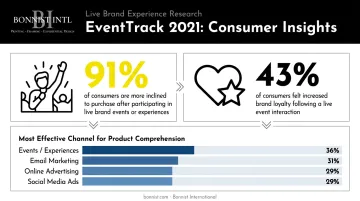
That last finding stands out: live experience beats every digital channel for product comprehension, and the margin isn't close.
Post-Pandemic Appetite for Physical Encounters
The years of digital-only interaction during the pandemic did something unexpected: they made people hungry for physical, tactile, socially meaningful brand encounters. EventTrack reported that 78% of consumers prefer brands' live, in-person experiences over digital equivalents — compared to just 8% who preferred digital events.
That preference is driving investment. Venues, hotels, and corporate offices are no longer treating their physical environments as functional necessities. They're treating them as strategic brand assets.
Trust That Digital Can't Replicate
Freeman's 2024 Trust Report, conducted with Edelman DXI across 1,800 consumers and business professionals, found:
- 77% reported increased trust in a brand after a live event interaction
- 64% retained positive impressions for at least one month after the experience
- 67% said they were likely to purchase products or services following an event
When a consumer physically inhabits a brand's world — walking a sponsor-branded stadium corridor, sleeping in a hotel room where the décor tells the city's story, working in an office where the architecture reflects company values — the brand stops being a logo. It becomes something experienced firsthand.
The Physical Environment as the Ultimate Brand Experience
Pop-ups and activations get attention. But the most durable form of experiential branding is the permanent physical environment — spaces that audiences return to repeatedly, where emotional resonance compounds over time.
What Makes a Space Experiential
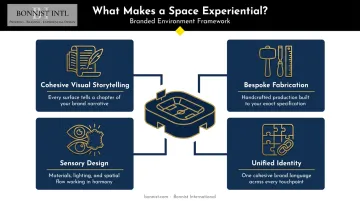
The difference between a generic space and a branded environment isn't budget — it's intentionality. Experiential environments combine:
- Cohesive visual storytelling — graphics that communicate brand narrative, not just logo placement
- Bespoke fabrication elements that signal craft and attention to detail
- Sensory design: materials, lighting, and spatial flow that shape how people feel
- Unified identity across every touchpoint, so nothing reads as an afterthought
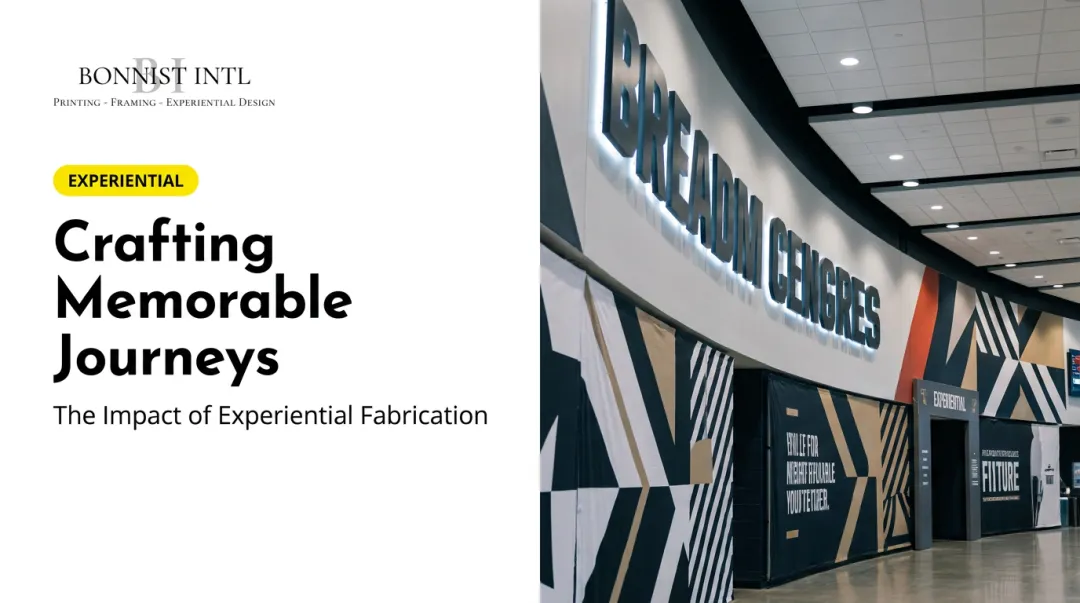
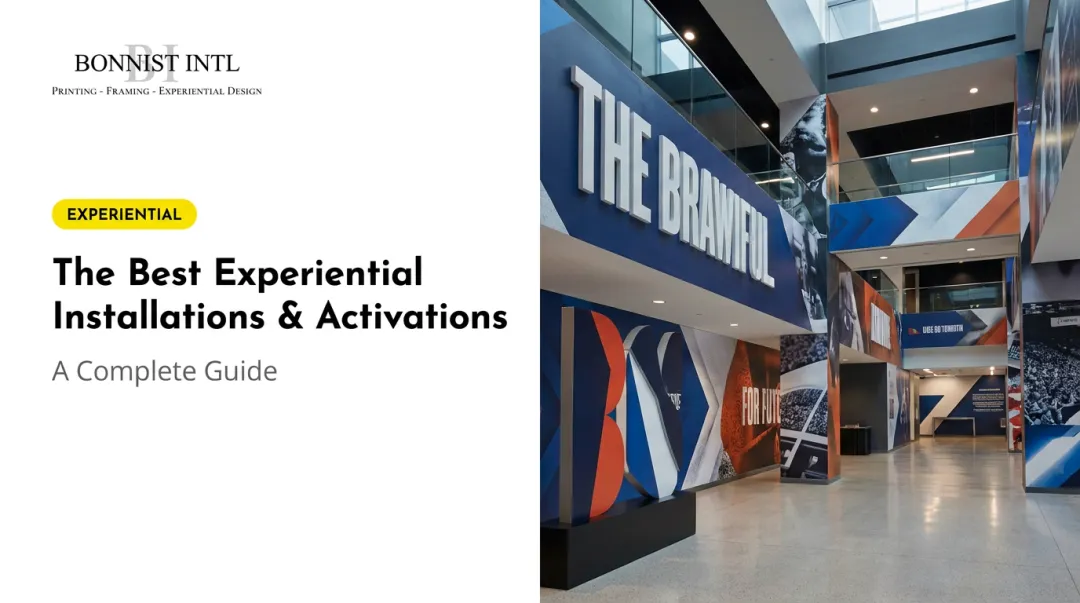
A generic stadium has signage. An experiential one has barrier covers, locker room graphics, windscreens, VIP suite vinyl, and corridor installations that together pull a fan into the team's world — not just seat them for a game.
Sports Venues: The Most Visible Application
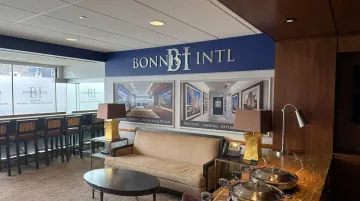
Bonnist International's work at MetLife Stadium illustrates the scope of what venue branding requires. The project included custom suite vinyl with Thursday Night Football branding for VIP spaces and over 40 printed, weather-resistant barrier covers for nationally televised events with Prime Video co-branding. A Prime Sports branded lounge featuring life-size player imagery completed the environment.
At Madison Square Garden, second-surface acrylic printed basketball photography turned a facility corridor into a museum-style branded environment. For NYCFC, branded windscreens featuring Etihad Airways co-branding transformed a training facility perimeter into a sponsor-visible, professionally presented environment — visible to players, staff, and visiting partners every day, not just on match day.
Hospitality and Corporate Settings
Hotels use physical branding differently — the goal is guest experience and social shareability. Bonnist's project at MSocial Hotel in downtown New York City involved designing and installing custom Dreamscape wallpaper across 450+ guest rooms, each featuring iconic NYC imagery (Broadway, Wall Street, the Charging Bull). Every guest wakes up inside the brand's story.
A 2020 peer-reviewed study in the International Journal of Hospitality Management found that hotel lobby design style significantly affects booking intentions — and that biophilic design elements improve guest satisfaction across generations. Physical environment isn't cosmetic. It drives behavior.
For corporate offices, the value is dual: inspire the team that works there daily, and impress the clients who visit occasionally. Common branded elements include:
- Wall graphics and corridor installations that reflect company culture
- Dimensional signage and frosted glass logos at entry points
- Direct-to-acrylic prints that double as both art and brand expression
The connection between environment and retention is measurable. Gensler's 2024 global workplace research found 97% of the most engaged employees said they were likely to stay with their company the following year, versus 53% of the least engaged.
Key Forms of Experiential Consumer Engagement
Spatial and Environmental Branding
This is the most permanent form — transforming a venue, office, or public space into a branded world. The tools include:
- Large-scale murals and custom wallpaper
- Direct-to-substrate printing (acrylic, metal, PVC, canvas)
- Dimensional signage and fabricated logo installations
- Silicone Edge Graphic (SEG) backlit displays
- Frosted glass and branded vinyl applications
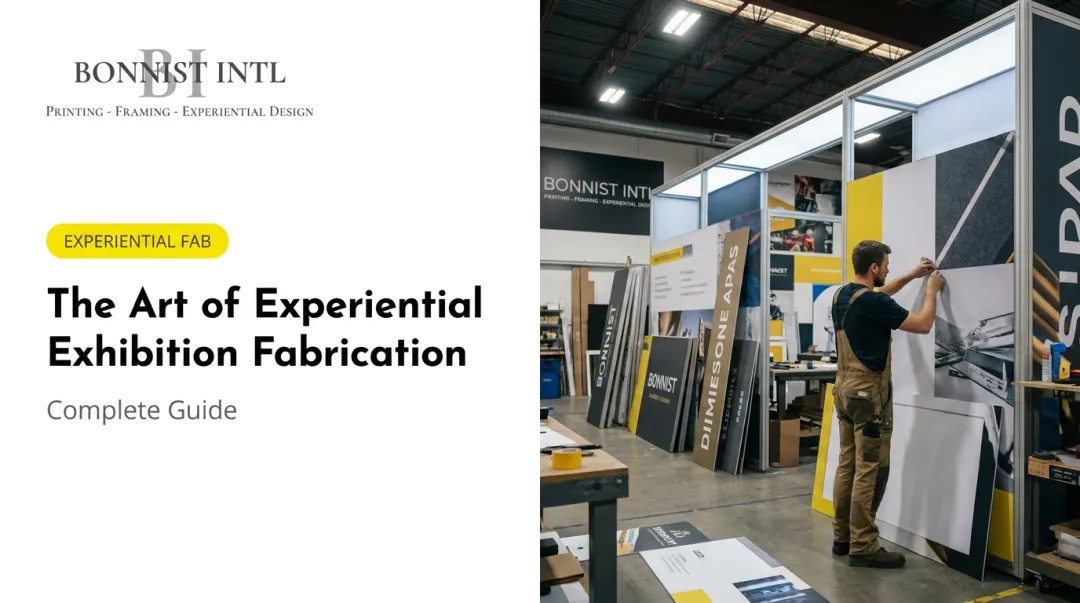
Bonnist International's production capabilities span all of these: CNC cutting, laser cutting, wide-format printing on rigid substrates, fabric graphics, and dimensional fabrication. The NYCFC headquarters project is a clear example: Dusted Crystal vinyl logos applied across interior and exterior glass throughout the building unified the brand from the entrance to every interior touchpoint.
Event-Based and Pop-Up Activations
Limited-time branded experiences create urgency and emotional peaks. Step-and-repeat banners, backlit event displays, custom barrier covers, and branded lounges generate concentrated exposure in high-traffic moments.
The tactics that drive engagement include:
- Interactive product demonstrations
- Augmented reality stations that reduce transaction friction
- Participatory challenges tied to social sharing
- Premium event environments (branded suites, VIP lounges) that reward loyalty
Digital-Physical Hybrid Experiences
The most effective activations don't stop at the venue door — they extend into digital channels. State Farm's 2023 geo-targeted AR scavenger hunt produced 1,328,215 footballs captured and 610 million brand impressions, layering digital mechanics onto a real-world activation. Adidas's AR product drop at ComplexCon reduced sneaker transaction time from over two hours to a few minutes.
QR integrations, app tie-ins, and social media-ready backdrops extend the experience beyond attendees. Bonnist builds broadcast-ready press backdrops and media walls specifically for this, maximizing brand and sponsor visibility across live broadcast and social channels simultaneously.
Brands Setting the Bar for Experiential Innovation
The brands doing this best share one trait: they stopped designing campaigns and started designing worlds.
Nike built the House of Go pop-up around the Epic React shoe — not a product display, but a sensory environment with movement-reactive art installations and immersive hands-on testing. The Nike by Melrose concept store rotated 25% of products every two weeks, using local consumer data to personalize inventory. Visitors to Nike House of Innovation flagships reportedly spent 30% more than typical retail shoppers.
Jeep ran Camp Jeep as a multi-country off-road experience program activated across 5+ continents, 15 countries, and 28 U.S. states. The 2019 edition drew over 1,500 participants. The activation wasn't about selling a vehicle — it was about placing Jeep owners inside the brand's identity as adventurers and community members.
Adidas used AR at ComplexCon to let attendees purchase limited-edition sneakers by pointing their phones at in-venue signage — eliminating the traditional drop-queue chaos and turning the physical event into the purchase point.
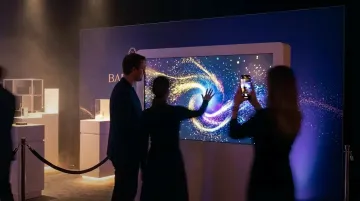
None of these brands were marketing a product. They were building a world their audience wanted to enter, share, and return to. That logic holds whether the audience is sneaker collectors at a pop-up or season-ticket holders walking into an arena for the first time. The environments that deliver that feeling are built — physically fabricated, installed, and maintained — and that production layer is where the experience either succeeds or falls flat.
How to Build an Experiential Branding Strategy That Works
Start With Story, Not Design
Experiential branding begins with a clear answer to one question: What do we want people to feel when they're inside our world? Brand research, audience understanding, and competitive context come before any design decision. Without that foundation, even a visually impressive environment fails to connect.
Bonnist International's process reflects this — starting every project with research into the brand, competition, target audience, and current trends before developing a single concept. That groundwork is what makes the next step — execution — matter so much.
Execute End-to-End
The gap between a strong concept and a powerful brand experience almost always lives in execution. Inconsistent materials, misaligned color across surfaces, and installation errors can each quietly undermine an immersive effect that took months to design.
Working with a specialist who manages concept through installation ensures consistency. Bonnist's end-to-end model — design, fabrication, and professional installation under one roof — is what makes projects like the 450+ room MSocial Hotel wallpaper installation or the MetLife Stadium suite graphics land at the quality level they do.
Build in Flexibility
Effective experiential branding doesn't require a permanent, all-or-nothing commitment. Scalable approaches include:
- Modular display systems (SEG frames, tension fabric displays) with swappable graphic panels
- Seasonal graphics updates for venues that rotate content between campaigns
- Campaign-specific installations layered onto permanent environments (event suite vinyl, branded barrier covers)
- Quick-change frames for venues that update player or sponsor imagery frequently
Bonnist describes its branded venue solutions as "flexible and scalable — ideal for seasonal updates or permanent installations." Brands that stay fresh without a full redesign maintain relevance without the cost of starting over.
Frequently Asked Questions
What is an experiential brand?
An experiential brand creates meaningful, emotionally resonant interactions and environments rather than relying solely on messaging. Consumers don't just see the brand — they feel it through physical spaces, live encounters, or sensory experiences that form genuine memory and loyalty.
What is an example of experiential branding?
Examples include Nike's pop-up activations, stadium environments that immerse fans in team identity year-round, and hotel rooms where custom artwork tells the host city's story. The format varies; the goal — making the brand something people inhabit — stays the same.
How does experiential branding differ from traditional marketing?
Traditional marketing delivers a message to a passive audience. Experiential branding places the consumer inside a live, physical, or interactive encounter. The result is emotional memory, not just awareness: consumers move from seeing a brand to genuinely feeling it.
Which industries benefit most from experiential branding?
Sports venues, hospitality brands, corporate offices, retail, and entertainment sectors see the strongest returns — because these are environments where audiences repeatedly inhabit the brand's physical world. The cumulative effect of repeated exposure to a well-branded space compounds in ways a single campaign cannot.
How do you measure the ROI of experiential branding?
Key metrics include social media reach, user-generated content volume, repeat visit rates, sponsor visibility data, and post-event brand sentiment. Freeman's 2024 research also recommends tracking trust lift and word-of-mouth intent. Unlike campaign advertising, physical environments build value gradually over time.