This isn't a purely aesthetic call. The format you choose directly affects image sharpness, installation longevity, how the piece performs under different lighting conditions, and whether you're reprinting in two years because the substrate warped or the finish clashed with the environment.
Both formats are widely used in commercial settings — and both are regularly misapplied. A canvas print in a branded corporate lobby can look out of place. A mounted print in a high-humidity hospitality space can delaminate. Getting this decision right upfront saves significant time, cost, and rework.
This guide breaks down exactly how mounted prints and canvas prints differ, where each format excels, and how to match the right format to your specific environment and goals.
TL;DR
- A mounted print is a photographic or digital image bonded to a rigid backing (foam board, gatorboard, PVC, or aluminum composite), producing a flat, frameless finish.
- A canvas print is an image printed onto woven canvas fabric and stretched over a wooden frame, creating a textured, gallery-style appearance with visual depth.
- Mounted prints preserve photographic sharpness and fine detail; canvas prints deliver a softer, artistic look with zero glare.
- Mounted prints suit corporate signage, branded environments, and precision photography displays.
- Canvas prints fit hospitality décor, large panoramic art, and immersive spaces.
- The right choice comes down to three factors: image type, display environment, and the visual effect you're after — all covered in the comparison below.
Mounted Print vs Canvas Print: Quick Comparison
| Dimension | Mounted Print | Canvas Print |
|---|---|---|
| Cost | Generally more affordable at standard sizes | Higher unit cost, but scales well for oversized formats |
| Composition | Photographic/fine art paper bonded to a rigid substrate | Inkjet printing on woven canvas, stretched over a wood frame |
| Durability | Susceptible to moisture and humidity over time | More resilient to humidity; may sag if stretcher bars are low quality |
| Aesthetic/Finish | Sharp, photographic clarity; flat or semi-matte surface | Soft, textured, painterly look; completely glare-free |
| Ideal Use Case | Branded corporate displays, detailed photography, text-heavy graphics | Artistic imagery, large statement walls, hospitality and experiential environments |
What Is a Mounted Print?
A mounted print is a high-quality photographic or digital image printed on paper (typically lustre, semi-matte, or fine art stock) and permanently bonded to a rigid backing material. The backing provides structural rigidity on its own, replacing the need for a traditional frame.
Substrate Options and What They Mean
The substrate choice matters as much as the print itself:
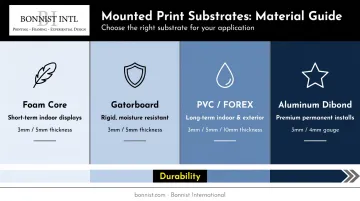
- Foam core (FOME-COR) — Polystyrene foam with paper facers; lightweight and cost-effective for short-term indoor displays. Available in thicknesses from 1/8" to 1/2".
- Gatorboard (GATORFOAM) — Extruded polystyrene bonded between wood-fiber veneer facers; significantly more rigid, with good moisture and warp resistance. Available from 3/16" to 3" gauges.
- PVC/FOREX board — Expanded rigid PVC with low water absorption and high impact strength; suitable for longer-term indoor use and certain exterior applications.
- Aluminum composite (DIBOND) — Two pre-painted 0.012" aluminum skins bonded to a polyethylene core; the premium option for permanent commercial installations. Weighs just 0.60–0.98 lb/sq ft depending on thickness, flat, and highly resistant to bowing.
Core Strengths of Mounted Prints
- Photographic sharpness and color fidelity are fully preserved — no canvas texture to soften fine detail
- Text, logos, and intricate graphics stay crisp and legible at any viewing distance
- The slim, frameless profile installs flush to walls with a clean, modern look
- Dibond handles thermal movement well; large panels still need expansion clearance at the mount points
Those strengths come with one real constraint worth planning around: climate sensitivity.
Key Limitations
Mounted prints require controlled conditions. The NEDCC recommends keeping photographic materials at 30–50% relative humidity with daily fluctuation under 10%. Paper-based mounts exposed to prolonged humidity can warp, blister, or delaminate. In a climate-controlled interior, this is rarely an issue. In anything less stable, substrate selection becomes the deciding factor.
Given those strengths and limitations, mounted prints tend to excel in specific contexts.
Where Mounted Prints Fit Best
- Corporate lobbies and branded office environments that demand precise photography and legible graphics
- Retail and event displays where sharpness and brand accuracy are non-negotiable
- Temporary or rotatable installations designed to be swapped out seasonally
- Museum and gallery-style photo exhibitions where image fidelity is the priority
What Is a Canvas Print?
A canvas print is an image printed — typically via giclée inkjet — onto a woven canvas fabric, usually a cotton-polyester blend or 100% cotton, which is then stretched tightly over a wooden stretcher bar frame and secured at the back. The result is a frameless, three-dimensional art piece that carries the visual warmth of an original painting.
Two primary presentation styles apply to commercial canvas:
Gallery Wrap vs Float Frame
- Gallery wrap: The image wraps around the sides of the stretcher frame, creating a seamless appearance that works without any additional framing. Standard stretcher bars run 1.25" deep; professional profiles reach 1.75".
- Float frame canvas: The stretched canvas sits inside a floating frame with a small visible gap, adding a refined, finished look suited to more formal or curated environments.
For very large canvases — anything beyond 48" in either dimension — cross braces become necessary to maintain structural integrity and prevent span-related sagging over time.
Core Strengths of Canvas Prints
- The matte canvas surface eliminates glare entirely, making canvas well suited to rooms with variable or high-intensity lighting
- Textured surface adds depth and dimension, particularly effective with landscapes, action photography, and atmospheric imagery
- Lightweight relative to size — large-format canvas installations are far more practical to handle and hang than equivalent rigid substrates
- With quality pigment inks and protective varnish, canvas prints can achieve 100+ years of certified display life
- Canvas output scales to very large dimensions — commercial printers can produce canvas up to 10 ft wide × 50 ft long
Key Limitations
Canvas isn't right for every application. Three limitations come up consistently in commercial projects:
- Woven texture softens fine photographic detail, making small text or intricate line work harder to read
- Canvas can sag over time if stretcher bars are low quality or the installation environment has significant humidity fluctuation
- The painterly aesthetic can feel out of place in environments that demand clinical precision or a formal corporate look
Where Canvas Prints Fit Best
- Hospitality environments (hotel lobbies, restaurants, event spaces) where warmth and artistic atmosphere drive the design
- Sports venues and arenas requiring large, immersive visual installations across corridors and gathering areas
- Senior living communities where a residential, welcoming aesthetic matters
- Corporate environments built around experiential storytelling rather than signage-style communications

Mounted Print vs Canvas Print: Which Should You Choose?
The format decision comes down to five factors: image content, installation environment, longevity requirements, aesthetic goals, and budget relative to scale.
Decide Based on Image Type
Choose mounted print if your artwork contains:
- Fine text or branded messaging
- Detailed product photography or portrait work
- Precise graphics where color accuracy is non-negotiable
Choose canvas if your artwork is:
- Painterly, atmospheric, or large-scale in composition
- Action photography used as a statement piece rather than documentation
- Abstract or brand imagery designed to evoke mood rather than communicate details
Decide Based on Environment
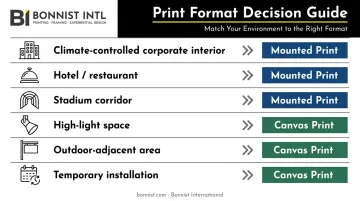
| Environment Type | Recommended Format |
|---|---|
| Climate-controlled corporate interior | Mounted print (gatorboard or dibond) |
| Hotel lobby or restaurant | Canvas print (gallery wrap or float frame) |
| Stadium corridor or arena concourse | Canvas print or second-surface acrylic |
| High-light or variable-lighting space | Canvas print (matte, glare-free surface) |
| Outdoor-adjacent or semi-exposed area | Dibond-mounted print or sealed canvas |
| Temporary or rotatable installation | Mounted print on foam core or gatorboard |
Situational Recommendations
The table above addresses individual spaces, but many organizations need both formats. Hotel groups, sports leagues, and corporate campuses typically use mounted prints for precision signage and canvas for large-scale art installations — each format doing a distinct job across the same environment.
Bonnist International works with clients across these exact verticals — from arena concourses to hotel lobbies to corporate campuses — helping teams determine which format fits each space before production begins.
Real-World Applications: Matching Format to Environment
Corporate and Branded Environments
In corporate lobbies, boardrooms, and branded office corridors, mounted prints on rigid substrates — particularly acrylic and aluminum composite — are the standard for good reason. They preserve the photographic accuracy and graphic precision that brand standards demand.
Bonnist International's work for a major sports and entertainment company illustrates this directly: high-resolution direct-to-acrylic prints installed across multiple office corridors and gathering spaces delivered a gallery-quality environment with the durability a permanent corporate installation requires.
SEGD has documented large-scale branded workplace environments — including Nike's New York headquarters spanning 150,000 sq ft across six floors — that demonstrate how precision-printed environmental graphics shape the daily experience of employees, clients, and partners.
Sports Venues and Hospitality Spaces
Stadiums, arenas, and hotel properties put different demands on printed materials. Visual atmosphere and physical scale matter more than fine detail — and the format has to hold up under variable lighting, foot traffic, and changing conditions. Canvas prints and specialty large-format media are better suited here because they're:
- Lighter and easier to install at scale
- Glare-free under mixed or theatrical lighting
- More forgiving when conditions shift between seasons or events
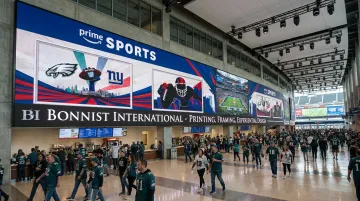
Bonnist International has delivered visual display solutions at venues including MetLife Stadium and MSG, where the format choice directly shapes what fans, guests, and athletes experience as they move through the space. For the MSocial Hotel NYC property, Bonnist executed custom-designed artwork across 450+ guest rooms — a scope that illustrates what consistent, large-scale hospitality execution actually looks like in practice.
The Strategic Takeaway
The wrong format choice doesn't show up immediately — it shows up two years later when a glare-heavy acrylic piece fails in a stadium concourse, or a canvas print looks out of place in a precision-branded boardroom. Format decisions affect brand perception, guest experience, installation longevity, and long-term maintenance costs. Matching substrate to environment and visual goals from the outset is what separates an installation that holds up for a decade from one that needs an early replacement.
Frequently Asked Questions
What does it mean if a print is mounted?
A mounted print is a photographic or digital image printed on paper and permanently bonded to a rigid backing material — such as foam board, gatorboard, PVC, or aluminum composite. The backing provides structural rigidity, eliminating the need for a traditional frame.
Is a print or canvas print better?
Neither is universally better. Mounted prints are the stronger choice for sharp photographic detail and corporate or branded environments. Canvas prints are better for artistic imagery, large-format impact, and spaces where a glare-free, textured finish is preferred.
What is the difference between a mounted print and a framed print?
A mounted print is bonded to a rigid backing and displayed without a traditional decorative frame — the substrate itself provides the structure. A framed print is a paper print enclosed in a decorative frame, often with a mat, giving it a more traditional, finished appearance.
Which lasts longer: a mounted print or a canvas print?
Longevity depends on environment and quality. Canvas prints with quality pigment inks can last well over a century under proper conditions, while mounted prints on premium substrates like dibond are extremely durable. Paper-based mounts, however, can delaminate or warp in humid environments over time.
Are canvas prints or mounted prints better for high-traffic commercial spaces?
Canvas prints on quality stretcher bars handle high-traffic areas well. For permanent commercial installations requiring both sharpness and durability, mounted prints on aluminum composite (dibond) are the stronger choice.
Can canvas prints or mounted prints be produced at very large scales?
Canvas is more practical at very large sizes, with commercial output exceeding 10 ft × 50 ft, and unstretched rolls ship without damage risk. Mounted prints at large scales require heavier rigid substrates like dibond to prevent warping, adding to both material weight and shipping cost.