This guide cuts through the noise. Whether you're outfitting a corporate headquarters, a sports venue, or a hospitality property, you'll find a clear breakdown of material composition, aesthetics, durability, cost, and the specific B2B contexts where each format earns its place.
Key Takeaways
- Acrylic prints offer vivid color saturation and glossy depth — the go-to for bold brand statements in controlled lighting
- Canvas offers a matte, warm, glare-free aesthetic at a significantly lower price point
- Acrylic outperforms on UV resistance and color vibrancy; canvas is lighter, less expensive, and handles bright or uncontrolled light better
- The right choice depends on lighting, image type, environment, budget, and audience
- For commercial installations, the material you choose directly shapes longevity, brand perception, and return on investment
Acrylic Prints vs Canvas Prints: Quick Comparison
Here's a side-by-side breakdown of the key differences — useful for project managers, designers, and procurement teams comparing options before committing.
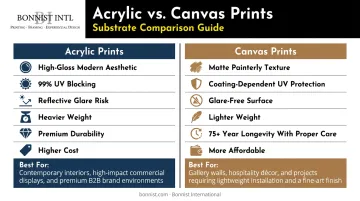
| Factor | Acrylic Prints | Canvas Prints |
|---|---|---|
| Aesthetics | High-gloss, modern, near-3D depth | Matte, textured, painterly, traditional |
| UV Protection | Up to 99% UV blocking (conservation-grade) | Depends on ink, media, and protective coating |
| Glare | Reflective; can produce glare in bright rooms | Matte, low-glare surface in any lighting |
| Weight | Heavier (0.73–1.49 lb/sq ft for acrylic sheet alone) | Lighter; easier to handle at large formats |
| Durability | Long-term with high UV and moisture resistance | 75+ years with tested ink/media systems and proper care |
| Price | Higher due to premium materials and mounting complexity | More affordable at comparable sizes |
| Best For | High-contrast imagery, controlled lighting, brand feature walls | Open lobbies, hospitality art walls, large-format venue installs |
What Is an Acrylic Print?
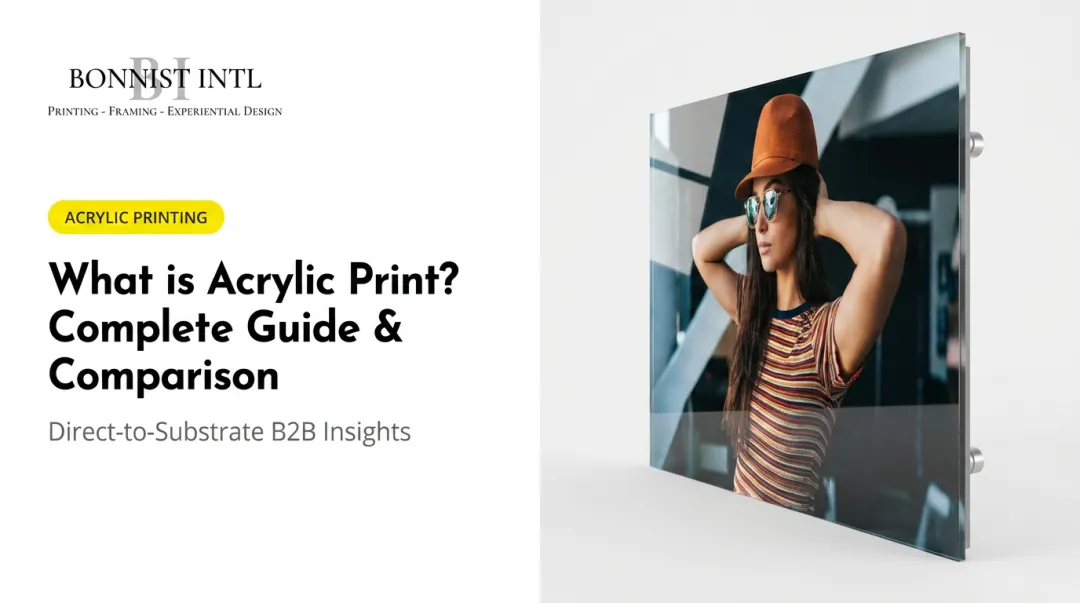
Acrylic prints fall into two production families. The traditional method — face mounting — bonds a professionally printed image behind a polished acrylic sheet, creating a sandwiched, protected display. The second method, direct-to-acrylic printing, applies ink directly onto the acrylic surface, producing sharp, vibrant results with fewer components.
Face mounting delivers the premium standard for gallery-quality output, while direct-to-acrylic printing has become increasingly common in commercial settings due to its efficiency and consistency. Bonnist International uses direct-to-acrylic printing as its primary method for corporate and sports venue installations, including projects at Madison Square Garden and major corporate offices across the sports and entertainment sector.
The Visual Effect
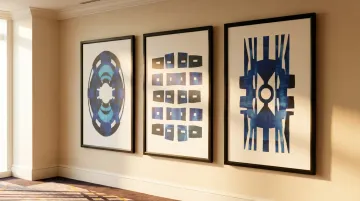
The acrylic layer refracts light rather than absorbing it, producing a luminous, near-backlit appearance. Colors appear more saturated, contrast deepens, and the image takes on a perceived three-dimensional quality that no other print substrate replicates at the same level. For high-resolution, high-contrast imagery — action photography, brand graphics, cityscapes — the effect is striking.
Durability Advantages
When conservation-grade acrylic is specified, UV protection is substantial. Tru Vue's Optium Museum Acrylic claims 99% UV blocking from 300nm to 380nm, less than 1.6% total reflection, and greater than 98% light transmission — though these figures apply to that specific product grade, not all acrylic prints universally.
Acrylic also provides full moisture resistance. Large commercial panels are often backed with aluminum Dibond — two 0.012-inch aluminum sheets around a polyethylene core — which adds structural support while remaining approximately half the weight of solid aluminum.
Limitations Worth Knowing
- Weight: ACRYLITE data shows acrylic sheet weighing 0.73 lb/sq ft at 1/8 inch and 1.49 lb/sq ft at 1/4 inch — before the print, backer, and hardware. Large-format installations require engineered mounting and wall-load assessment
- Glare: The glossy surface reflects windows and light fixtures in bright or naturally lit rooms
- Fingerprints and micro-scratches: Acrylic requires careful handling and specific cleaning protocols
- Cost: Higher price point than canvas at comparable sizes
- Image sensitivity: Low-resolution or soft-toned images are less forgiving on a high-gloss, high-contrast surface
Those limitations aside, the right environment turns every one of them into a non-issue.
Where Acrylic Performs Best
In commercial B2B settings, acrylic earns its place in:
- Corporate reception areas and executive offices where a premium, gallery-quality aesthetic signals brand authority
- Sports arenas and entertainment venues where bold, high-contrast imagery commands attention from a distance
- Hotel lobbies and high-impact hospitality spaces where a sleek, modern installation elevates the guest experience
- Corridors and gathering spaces requiring durable, wipeable, gallery-grade art at scale
What Is a Canvas Print?
Canvas prints start with an image printed directly onto a coated poly-cotton or museum-quality canvas using archival inkjet (giclée) printing. The printed canvas is then hand-stretched and wrapped over a wooden stretcher frame (gallery wrap), creating a frameless look by extending the image around the sides.
Commercial canvas substrates are typically specified at 385–400 gsm. Canson Infinity Museum ProCanvas Water Resistant, for example, is a 100% cotton, OBA-free product available in matte or lustre. Hahnemühle Daguerre Canvas is 400 gsm, poly-cotton, acid-free, and ISO 9706 compliant.
The Visual Character
Canvas has a subtle texture that softens edges and adds a painterly quality to any image. Colors appear more muted and natural compared to acrylic — an effect many clients actively prefer for portraiture, lifestyle photography, and warmer interior environments. That's a deliberate aesthetic choice, not a compromise.
Practical Advantages
- Glare-free: Professional canvas products have matte surfaces that perform well in naturally lit or window-heavy rooms
- Lighter weight: More manageable for large multi-panel installations and venues with variable hanging infrastructure
- Forgiving on resolution: The canvas texture softens the appearance of images that might look pixelated on high-gloss acrylic
- Cost-effective at scale: Significantly more affordable per square foot, making large-format installs more feasible
Durability and Limitations
Canvas longevity depends directly on which ink/media system you use and where the piece is displayed. Wilhelm Imaging Research's testing with Canson Infinity media and Epson UltraChrome HDX inks supports display permanence ratings of 75+ years under specified conditions — a rating tied to that specific tested system, not a blanket guarantee for all canvas prints.
Untreated canvas is more vulnerable than acrylic to:
- UV exposure and color fading in high-light environments
- Humidity and moisture (NEDCC recommends 30–50% RH for photographic materials)
- Abrasion and snagging on sharp edges
- Airborne soiling in high-traffic spaces
UV-protective varnish extends the life of a canvas print, but durability ultimately comes from the full ink/media/display system — not the coating alone.
Where Canvas Performs Best
Canvas is the right call for:
- Senior living communities and healthcare settings where warm, calming aesthetics support resident wellbeing
- Hospitality guest rooms and lounges with abundant natural light where glare-free art matters
- Large corporate common areas and hallways that require cost-effective large-format installs
- Brand heritage photography, landscapes, and portraiture where a timeless, approachable feel is the design goal
Acrylic vs Canvas: Which Is Right for Your Space?
Neither format is universally better. The decision comes down to five factors:
- Lighting conditions — Does the space have controlled ambient lighting or abundant natural light?
- Aesthetic intent — Is the goal modern and bold, or warm and approachable?
- Image type — High-contrast action photography or soft-toned lifestyle imagery?
- Scale and budget — What's the square footage, and what's the cost ceiling?
- Environmental exposure — Is humidity, direct sunlight, or high cleaning frequency a factor?
Situational Recommendations
Choose acrylic when:
- Maximum visual impact is the priority — brand walls, statement lobbies, VIP environments
- Lighting is controlled and the space is designed to showcase the work
- Imagery is high-resolution, high-contrast, and color-rich
- The audience will interact closely with the piece and the material quality will be noticed
Choose canvas when:
- Outfitting large spaces cost-effectively across many panels or rooms
- The environment is naturally bright or prone to humidity
- A warm, approachable aesthetic better serves the audience — senior living common areas, hotel guest rooms, community spaces
- Soft-toned imagery (landscapes, portraits, heritage photography) is the visual content
Scale and Installation Reality
Acrylic's weight demands professional mounting and wall-load review for large formats. A 48 x 72-inch panel using 1/4-inch acrylic sheet alone weighs roughly 35+ lbs before the backer, print, and hardware are factored in — and industry fabrication standards call for engineered fastening with thermal expansion allowances, not improvised hanging systems.
Canvas scales more flexibly for multi-panel installations and spaces with variable hanging infrastructure. It's easier to manage logistically across large projects, which is part of why it remains the practical choice for wide-coverage hospitality and senior living environments.
What Large-Scale Commercial Projects Actually Require
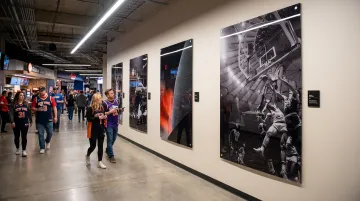
Material selection looks different when you're spec'ing for a venue rather than a single room. In high-foot-traffic corridors — like those at MSG, where Bonnist completed second-surface acrylic panel installations featuring dynamic basketball photography — UV resistance and durability under mixed lighting aren't preferences. They're requirements. Materials need to hold up under ambient light and high-touch conditions without degrading over a season.
In hospitality and senior living, the tactile warmth of canvas often creates a more emotionally resonant environment than the sleekness of acrylic. The goal in a senior living lounge isn't visual impact at 30 feet — it's comfort and familiarity at close range.
For organizations managing large-scale visual environments — from venue branding to corporate art programs — material choice is one decision inside a larger project: design, substrate spec, mounting method, and installation sequencing all interact. Bonnist International has spent over 33 years working through exactly these projects with sports teams, hospitality brands, and corporations, from the first substrate recommendation to final installation.
Conclusion
Acrylic and canvas serve different aesthetic goals, practical requirements, and budget realities. Neither wins outright. The best choice is determined by the environment, the image, and the impression you need to leave.
For consumer purchases, the differences are largely stylistic. For commercial installations, they translate to measurable outcomes: visitor engagement, brand perception, and long-term asset value. Whether you're equipping a sports arena with bold brand walls, furnishing a hotel lobby with statement pieces, or outfitting corporate offices with a consistent visual identity, the print format directly shapes the result.
For commercial installations where material selection needs to align with design vision and structural requirements, working with a specialist matters. Bonnist International has spent 33 years producing acrylic prints, canvas prints, and large-scale visual environments across stadiums, hotel lobbies, and corporate offices — from concept through installation.
Frequently Asked Questions
Are acrylic prints better than canvas?
Neither is objectively better — acrylic excels in vibrancy, UV resistance, and modern aesthetics, while canvas wins on affordability, glare-free display, and warmth. The best choice depends on the image type, lighting conditions, and environment where the print will be displayed.
What are the downsides of acrylic prints?
The main drawbacks are higher cost, heavier weight requiring robust mounting hardware, and a glossy surface that can reflect light and show fingerprints. Acrylic is also less forgiving for low-resolution images, which can appear more obviously pixelated on a high-gloss surface.
Which lasts longer, acrylic or canvas prints?
Acrylic generally outlasts untreated canvas due to superior UV and moisture resistance. Conservation-grade acrylic is built for long-term performance, while canvas can reach 75+ years with quality ink systems and proper care in dry, low-UV environments.
Can acrylic prints be used in commercial or high-traffic spaces?
Acrylic is well-suited to commercial environments due to its durability, UV protection, and premium appearance. Placement should account for lighting conditions to minimize glare, and professional mounting is essential for large-format pieces.
Are canvas prints a good choice for hospitality or senior living environments?
Canvas is often preferred in these settings for its warmth, matte surface in naturally lit spaces, lighter weight for easier installation, and the approachable, timeless aesthetic it creates — qualities that suit the comfort-focused goals of hospitality and senior living design.
How do you clean and maintain acrylic vs canvas prints?
Clean acrylic with a soft microfiber cloth and an ammonia-free cleaner applied to the cloth, not directly to the surface. Avoid harsh chemicals that can scratch or cloud the finish. Canvas needs only light dusting and should stay away from humidity and direct moisture.