Introduction
Audiences have changed. Where a branded banner or static lobby display once sufficed, today's visitors — fans, guests, employees, clients — expect to feel something when they enter a space. They want to be immersed in it, moved by it, and compelled to share it.
This shift isn't anecdotal. According to Freeman's Trust Report, 77% of consumers reported increased trust after a live brand interaction, and 67% were more likely to purchase following a live brand experience.
Global experiential marketing spending reached $139 billion in 2025. Organizations across every sector are responding to what audiences now demand.
This guide covers everything you need to know:
- What experiential installations and activations actually are
- The five primary formats used today
- Real-world examples organized by industry
- What separates impactful activations from forgettable ones
- How to find the right fabrication partner
Key Takeaways
- Experiential installations are purpose-built environments that immerse audiences at a sensory and emotional level, well beyond what static signage can achieve
- The most effective activations combine multisensory design, strategic storytelling, and deliberate space planning
- Sports venues, hospitality brands, and corporate offices are all investing heavily in experiential environments
- End-to-end fabrication capability, from concept through installation, is the single biggest determinant of activation success
- Global experiential marketing spending hit $139 billion in 2025, with 74% of Fortune 1000 marketers planning to increase spend that year
What Are Experiential Installations & Activations?
An experiential installation is a purpose-built physical environment or large-scale display that invites audiences to engage with a brand, story, or space on a sensory and emotional level. What separates it from traditional signage is interactivity, scale, and intentionality. A wall vinyl in a stadium corridor is decor. A floor-to-ceiling athlete mural — surrounded by illuminated graphics and fabricated structural elements, designed to evolve with each new signing — is a system built to communicate identity.
Installation vs. Activation: What's the Difference?
These terms are often used interchangeably, but they describe distinct concepts:
- Installation — a semi-permanent or permanent branded environment built into a space (a stadium heritage wall, a hotel lobby mural, a corporate branded atrium)
- Activation — a time-bound, event-driven experiential moment (a Thursday Night Football branded fan zone, a product launch pop-up, a trade show exhibit)
The best campaigns use both in concert. A venue might maintain a permanent installation that serves as the anchor identity of a space, while activating around it seasonally with event-specific graphics and fabricated elements.
The Field Today
The Society for Experiential Graphic Design (SEGD) defines the professional field as a multidisciplinary community spanning exhibition designers, fabricators, architects, and creative technologists — all working to make the built environment more engaging. That range reflects how the discipline has matured: experiential design now sits at the intersection of architecture, marketing, and fabrication — and clients across sports, hospitality, and corporate sectors are treating it as a strategic investment, not an afterthought.
Types of Experiential Installations & Activations
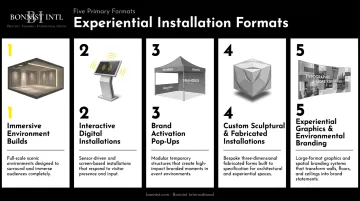
Five primary formats define the field today. Most real-world projects blend two or more.
1. Immersive Environment Builds
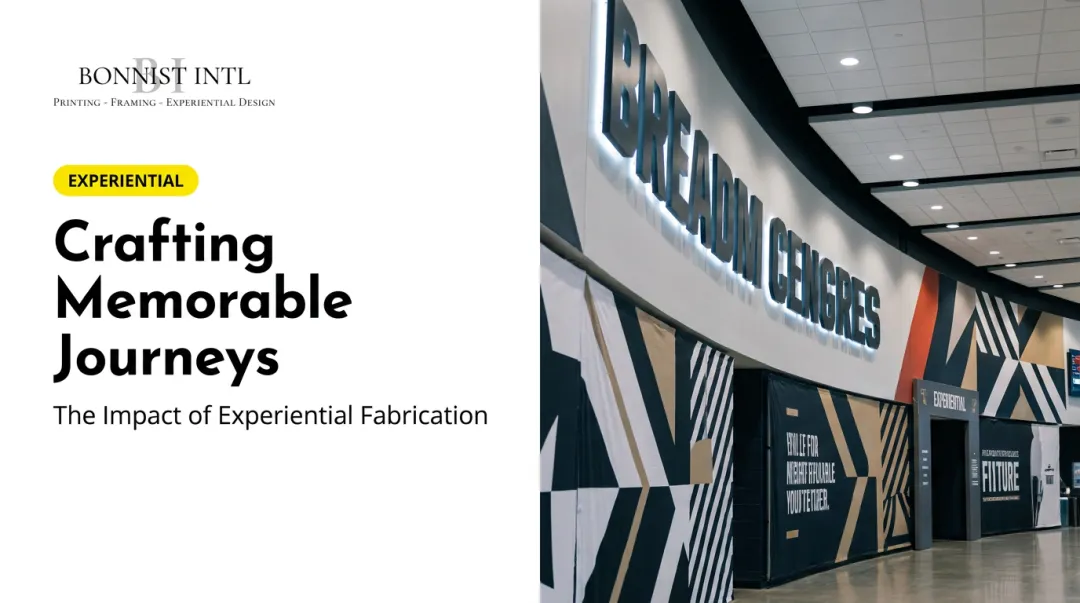
Entire rooms or zones transformed through fabricated elements, large-scale murals, experiential graphics, and custom décor. Think stadium tunnel experiences, branded hotel lobbies, or a corporate headquarters atrium that communicates the company's entire brand story across walls, floors, and ceilings.
2. Interactive Digital Installations
Sensor-driven or projection-mapped environments that respond to audience movement or input — motion-reactive displays, digital art walls, touchscreen activations. These attract outsized media coverage but require substantial technical infrastructure and ongoing content management.
3. Brand Activation Pop-Ups
Temporary, high-impact experiential moments designed for events, launches, or sponsorship touchpoints. Barrier covers for a nationally televised sporting event, a branded fan zone at a championship venue, a step-and-repeat backdrop system for a press moment.
4. Custom Sculptural & Fabricated Installations
Three-dimensional pieces — hand-crafted or CNC-fabricated — that anchor a space visually. Examples include dimensional signage, fabricated lettering, branded sculptures, and architectural elements built from acrylic, metal, and brass.
5. Experiential Graphics & Environmental Branding
Large-format printed or illuminated visual systems applied to walls, floors, ceilings, and facades. This includes SEG (Silicone Edge Graphic) backlit displays, direct-to-substrate printing, custom wallcoverings, vinyl systems, and perimeter fence graphics.
For B2B clients, physically fabricated environments often outperform digital-only formats on long-term ROI. They're durable, scalable, and carry no ongoing content infrastructure costs.
The Best Experiential Installations & Activations by Industry
The most useful way to evaluate what's possible is through the lens of your own sector. Here are the standout formats and real-world examples, organized by industry.
Sports & Entertainment Venues
Sports venues use experiential installations to build team identity and deepen the game-day experience. The most effective projects convert entire zones into cohesive brand environments — not just a logo on a wall, but a fully realized sense of place.
What this looks like in practice:
- Floor-to-ceiling athlete murals in player tunnels and corridors
- Championship heritage walls in club history areas
- Sponsor activation zones with fabricated structures and branded environmental graphics
- VIP suite branding with event-specific vinyl systems
MetLife Stadium's ongoing fan experience upgrades ahead of the NFL season — including plaza activations and fan zones — illustrate what venue-level investment in experiential infrastructure looks like at scale. MSG's partnership with Infosys on technology-led fan experiences demonstrates how entertainment venues layer digital activation onto a physical branded foundation.
Modularity matters here. New signings, playoff campaigns, and seasonal sponsor rotations mean installations need to be designed for refresh from day one. Quick-change frame systems, SEG display structures with swappable fabric graphics, and repositionable vinyl all make seasonal updates practical without requiring full reinstallation.
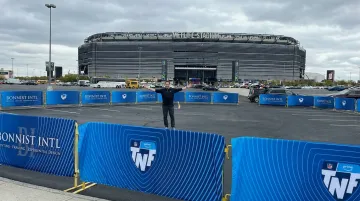
Bonnist International has delivered multiple projects in this category — including over 40 custom-printed outdoor barrier covers for a Thursday Night Football broadcast event at MetLife Stadium, custom windscreens for NYCFC's training facility (featuring both NYCFC and Etihad Airways sponsor branding), and second-surface acrylic photography installations in an MSG facility corridor. Each project was engineered with event timelines in mind, with materials selected for both visual impact and durability.
Hospitality & Hotel Spaces
Leading hospitality brands use experiential design to differentiate the guest experience and create spaces guests genuinely want to photograph and share. The challenge is cohesion: every touchpoint — lobby, corridor, restaurant, guest room — must feel on-brand while still surprising guests at each turn.
The most effective approach uses narrative progression: the lobby establishes a thematic anchor, while corridors, guest rooms, and dining spaces each extend that story in a distinct way — rather than repeating the same graphic across every surface.
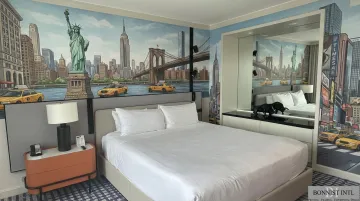
Bonnist's work for MSocial Hotel NYC is a strong case study here. The team created a custom artwork concept from scratch — merging iconic New York City visuals including Broadway, Wall Street, and the Charging Bull — and printed it onto Dreamscape wallpaper, a premium wallcovering chosen for its texture, durability, and high-definition print quality. The result was installed across 450+ guest rooms, transforming each room into an immersive, location-specific experience rather than a generic hotel interior.
Key fabrication elements in hospitality installations:
- Custom printed wallcoverings for large-scale narrative murals
- Direct-to-substrate prints (acrylic, metal, canvas) for individual room art and feature walls
- Backlit lobby signage and dimensional lettering for arrival experiences
- Branded glass films for corridors, conference spaces, and transitional zones
- Custom framed art programs scaled consistently across multi-room properties
Corporate Offices & Branded Environments
Forward-thinking organizations use experiential installations in headquarters and office campuses to reinforce brand culture, impress clients, and give employees spaces they're proud to work in. Gensler's 2024 Global Workplace Survey of over 16,000 office workers found that 97% of the most engaged employees were likely to stay with their company — compared to just 53% of the least engaged. The workplace environment is a meaningful factor in that equation.
Corporate installations need to balance aesthetic impact with professional credibility. Bold, but not disruptive. The best corporate environments use a consistent visual language across all branded touchpoints — from the reception desk to the boardroom.
Bonnist has delivered this for NYCFC's headquarters, applying custom Dusted Crystal vinyl logos across glass panels throughout the office — creating a refined, frosted aesthetic that reinforces team identity without overwhelming a professional workspace. A separate project for a major sports and entertainment company involved direct-to-acrylic prints in corridors and gathering spaces, creating a gallery-quality environment that doubled as a brand showcase.
Common corporate installation formats:
- Dimensional reception area signage (fabricated lettering, 3D logos)
- Branded glass films for conference rooms and glass-partitioned offices
- Mission and values wall graphics in high-traffic common areas
- Direct-to-acrylic or metal prints for hallway gallery installations
- Lobby video walls or illuminated SEG displays as focal-point brand statements
Event & Marketing Brand Activations
Brands use temporary experiential activations at live events to create memorable, shareable touchpoints. EventTrack 2026 research found that 61% of consumers were more inclined to purchase after a live event, while 85% of B2B attendees felt more educated after participating. The physical event environment is doing real marketing work.
Strong activations share three qualities: fabrication quality that holds up under event conditions, spatial storytelling that gives attendees something to engage with, and design that photographs well enough to travel beyond the event itself.
Bonnist's event portfolio includes step-and-repeat banner systems (including an NBA x AWS co-branded backdrop), backlit SEG display stands for national sports leadership summits, and the TNF barrier cover program — where over 40 custom-printed, weather-resistant fabric barriers transformed crowd-control infrastructure into high-visibility sponsor real estate visible to a national broadcast audience.
Common event activation formats:
- Step-and-repeat banner systems for press and photo moments
- Backlit SEG display stands for trade shows and summits
- Custom-printed fabric barriers for broadcast-visible sponsor placement
- Branded pop-up structures with environmental graphics
- Co-branded backdrops for partnership and sponsorship activation
What Sets the Best Experiential Installations Apart
Budget and technology matter, but they're not the deciding factors. The installations that earn long-term recall share characteristics rooted in craft, intention, and design strategy.
Narrative Depth
Every great installation begins with a clear story — one that defines the audience, the intended emotional response, and what the brand or space needs to communicate. Installations built around strong narrative have longer lifespans and stronger emotional recall — not because they follow a formula, but because they give visitors something to connect with beyond surface aesthetics.
A 2024 systematic review on narrative transportation confirmed that narrative structure is a necessary condition for genuine audience engagement — present content isn't sufficient; it must be organized into a meaningful arc that draws viewers in.
Multisensory Design
The most impactful installations engage more than sight. Research published in the Journal of Consumer Psychology by Krishna (2011) established that engaging multiple senses affects perception, judgment, and behavior in ways that single-sense stimulation cannot replicate. A 2025 study confirmed that five sensory cues — visual, auditory, olfactory, tactile, and taste — each independently influence brand experience and loyalty.
In practice, this means:
- Tactile surfaces, dimensional fabricated elements, and material variety that reward touch
- Environments sized to surround visitors, not merely decorate the periphery
- Ambient audio or soundscapes layered into the physical space
- Backlit displays, illuminated signage, and deliberate contrast between lit and unlit zones
Fabrication Quality
A concept can be inspired and still fail in execution. Thin materials, misaligned graphics, and weak structural elements erode the experience before a visitor can fully engage with it. Durable installations require fabricators who understand how design and material interact under real-world conditions — outdoor weather, heavy foot traffic, broadcast lighting, hospitality wear cycles.
Social Media as a Design Criterion
Installations designed with shareable moments in mind — dramatic scale, bold color, unusual textures — extend their own reach every time a visitor posts. The best activation briefs treat shareability as a functional design requirement, not a hoped-for side effect.
Scalability and Flexibility
The best fabricated environments are designed with future updates built in from the outset — modular panel systems, SEG frames built for fabric swaps, repositionable vinyl for event-specific refreshes. That flexibility lets a single installation serve a brand across multiple seasons, campaigns, or venue configurations.
How to Choose the Right Experiential Installation Partner
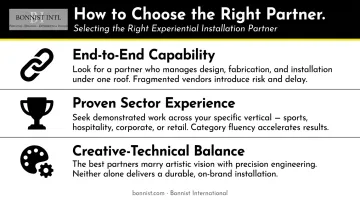
Choosing the wrong partner usually becomes obvious too late — after installation, when fixes are expensive. Three criteria matter most:
End-to-end capability — Can they handle concept, design, fabrication, and installation without distributing work across multiple subcontractors? Every handoff introduces risk: misaligned expectations, quality gaps, timeline delays.
Proven sector experience — Have they delivered for clients in your specific industry? A partner who has worked in sports venues understands broadcast visibility requirements, event timelines, and seasonal refresh cycles. A partner who has worked in hospitality understands multi-room consistency, durability standards, and the visual cohesion challenge across an entire property.
Creative-technical balance — Can they translate a brand story into a physically built environment with both aesthetic quality and structural durability? Design-only studios and fabrication-only shops both fail this test.
Common mistakes to avoid:
- Choosing a vendor solely on price — fabrication quality is not easily recovered after installation
- Briefing a partner without enough context about the audience and the space
- Working with studios that specialize exclusively in digital installations and lack physical fabrication experience
The most successful client-partner relationships begin with a deep discovery process — research into the brand, the audience, the space, and the goals — not with a quote.
Bonnist International puts this into practice. With over 33 years of experience in visual display solutions, experiential design, and fabrication — and a client roster that includes NYCFC, MetLife Stadium, MSG, and MSocial Hotel NYC — Bonnist delivers end-to-end capability across sports, hospitality, and corporate environments. Their "Inspired Fabrication" process starts with brand research and audience context before any material decisions are made, running from concept through installation under one roof.
If you're planning an installation or activation, reach out to the Bonnist team to start a conversation.
Frequently Asked Questions
What is an immersive art installation?
An immersive art installation is an environment designed to surround and engage an audience through multiple senses — using large-scale visuals, fabricated structures, sound, and spatial design so visitors feel physically inside the experience rather than observing it from a distance. The goal is full environmental engagement, not passive viewing.
What is an example of experiential design?
A stadium fan zone featuring large-format athlete murals, custom fabricated display structures, and branded interactive touchpoints is a clear example. The functional space — corridors, plazas, concourses — becomes a memorable brand environment that reinforces team identity and enhances the event experience for every attendee.
What are the five types of installation art?
The five primary formats are: immersive environmental builds, interactive digital installations, brand activation pop-ups, custom sculptural and fabricated installations, and experiential graphic environments. Most real-world projects combine two or more of these formats within a single activation or venue.
How much does an art installation cost?
Costs vary widely based on scale, materials, and complexity. Smaller environmental graphic programs may start in the low five figures; mid-scale fabricated installations typically range from $50,000 to $500,000; and large permanent venue environments can exceed seven figures. A scoped estimate from your vendor is the only reliable way to assess investment.
What is the difference between experiential marketing and an art installation?
Experiential marketing activations are campaign-driven and temporary, focused on a specific audience action — engagement, purchase, or social sharing. Art installations are often permanent or semi-permanent, prioritizing aesthetic and emotional impact. In venues and hospitality contexts, the two increasingly overlap.
How long does it take to design and install an experiential installation?
Smaller brand activations and environmental graphics can often be turned around in 4–8 weeks. Large-scale fabricated installations at sports venues or hotel properties typically require 3–6 months from concept to completion, covering design approvals, fabrication, and installation. Timeline depends heavily on scope and complexity.